Trolling with an electric motor: speed, mounting and rigging
Trolling with an electric motor means pulling a lure behind the boat at a slow, steady speed under battery power instead of the outboard. It works because an electric motor holds a low speed without surging, makes very little noise above or below the water, and can be left running for hours while you fish. The same idea scales from a bass boat with a bow mount down to a sit-on-top kayak with a small transom-clamped unit.
Getting it right is mostly a rigging job rather than a fishing one. The motor has to be mounted where it can steer the boat, the shaft has to be long enough that the propeller stays buried in a chop, the battery and cable have to carry a surprisingly large current, and the circuit needs protection you can reset at the helm. After that, the fishing side is about matching line and lures to the narrow band of speed an electric motor actually holds.
This guide covers mounting position, thrust and shaft length, wiring and protection, security hardware, and the trolling line and lures that suit electric speeds. GearPort does not sell trolling motors themselves, so nothing here recommends a motor model. It covers the parts that go around one.
What trolling with an electric motor actually involves
Trolling is a search technique. You put one or more lures in the water, move the boat slowly, and cover ground until something eats. An electric trolling motor suits it because it produces smooth, continuous thrust at speeds a petrol outboard struggles to hold. Most outboards idle faster than a walleye or trout wants a lure moving, and they vibrate while doing it.
An electric motor also turns the boat without a wake of noise. In shallow water, over clear flats, and around fish that have been pressured all weekend, that quiet matters more than any lure choice. The motor becomes the primary drive for the fishing part of the day, with the outboard only used to get to the spot and home again.
The limit is endurance. A trolling motor converts battery energy into thrust, and the battery is finite. A day of trolling is a planning exercise: how many amps the motor draws at the speed you fish, how long you want to fish, and how much reserve you keep for getting back. The guide on trolling motor batteries covers the sizing side in detail, and this guide assumes you will read it before you buy a battery.
One habit worth building early: run the motor at the lowest speed setting that holds your lure depth and direction. Current draw climbs steeply with speed, so the difference between setting three and setting seven is not a small one on the water.
Bow mount, transom mount and kayak mount
There are three practical places to put an electric motor, and the choice is mostly decided by the boat.
A bow mount sits on the foredeck and pulls the boat from the front. Pulling steers more precisely than pushing, so a bow mount holds a trolling line through wind and chop with less correction. It is the standard on bass boats and most dedicated fishing hulls, and it is the mount that supports foot pedal control and GPS anchor functions. It needs a flat, solid deck area and often a reinforcing plate under the mounting bolts.
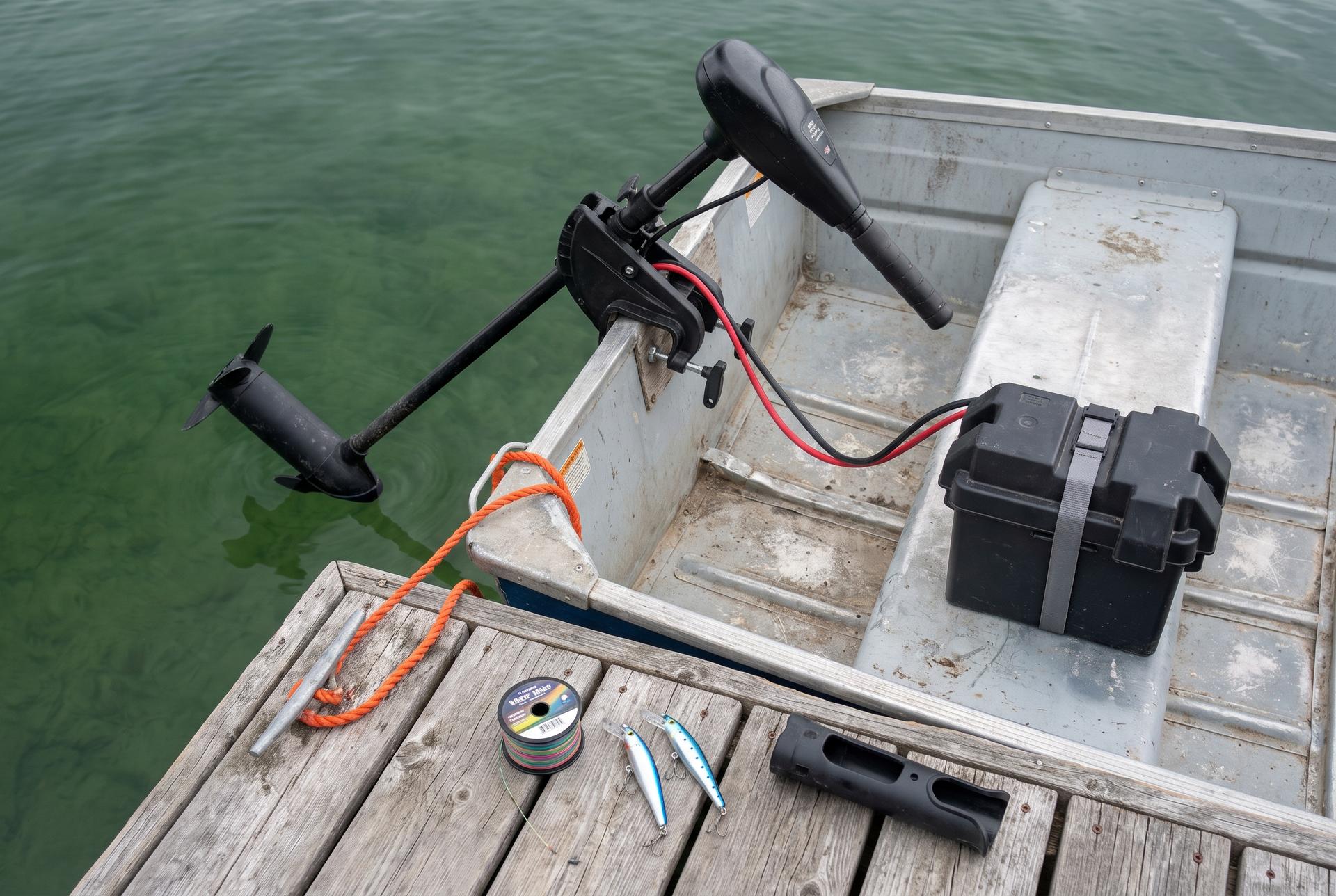
A transom mount clamps to the transom, the flat panel across the back of the boat, usually beside the outboard. It is cheap, it needs no deck space, and it moves between boats in a few minutes. Steering is by hand on the tiller, which is fine for trolling in a straight line and awkward when you want to fish and steer at once. On a jon boat, a tiller skiff or an aluminium runabout, a transom mount is usually the right call.
A kayak mount is a transom or gunwale bracket sized for a small hull. Sit-on-top fishing kayaks are the common case. Some have a factory motor mount or a transom plate built in, some take a clamp-on bracket on the stern, and some use a side-mount arm on a gunwale track. Check what your hull is designed to accept before buying anything, because clamping to an unreinforced kayak gunwale is how rails get cracked. Weight is the other kayak constraint: motor plus battery plus mount all sit high and behind you, and a kayak notices every pound.
Thrust, shaft length and how a kayak changes the numbers
Thrust is measured in pounds and is a measure of push, not speed. More thrust moves a heavier boat, and moves it against more wind, but it does not make a light boat go faster in any useful way. A kayak with a large motor on the back still tops out where hull speed says it does, it just gets there using more battery.
Manufacturers publish thrust recommendations by boat weight, and those are the figures to work from. Weigh the boat loaded, not the bare hull: battery, tackle, cooler, fuel and people all count. If you fish big open water where wind pushes you off a troll line, size up from the recommendation rather than down.
Shaft length is the one people get wrong. The propeller needs to stay fully submerged when the boat is pitching, not just when it is sitting still at the dock. The usual approach is to measure from the top of the mounting surface, the bow deck or the transom top, down to the waterline, then choose a shaft that puts the motor head at a comfortable height with the propeller well under. Add length if you fish rough water, and add length for a bow mount, because the bow lifts.
On a kayak, the measurement is short and the margin is thin. The hull sits low, so a standard transom motor shaft is often longer than needed and the shaft has to be trimmed up in the bracket to avoid grounding the prop in shallow water. Check that whatever mount you use lets you adjust shaft depth easily, and that the motor can be tilted clear for launching and landing through surf or over a ramp.
Holding a trolling speed, and the line and lures that match it
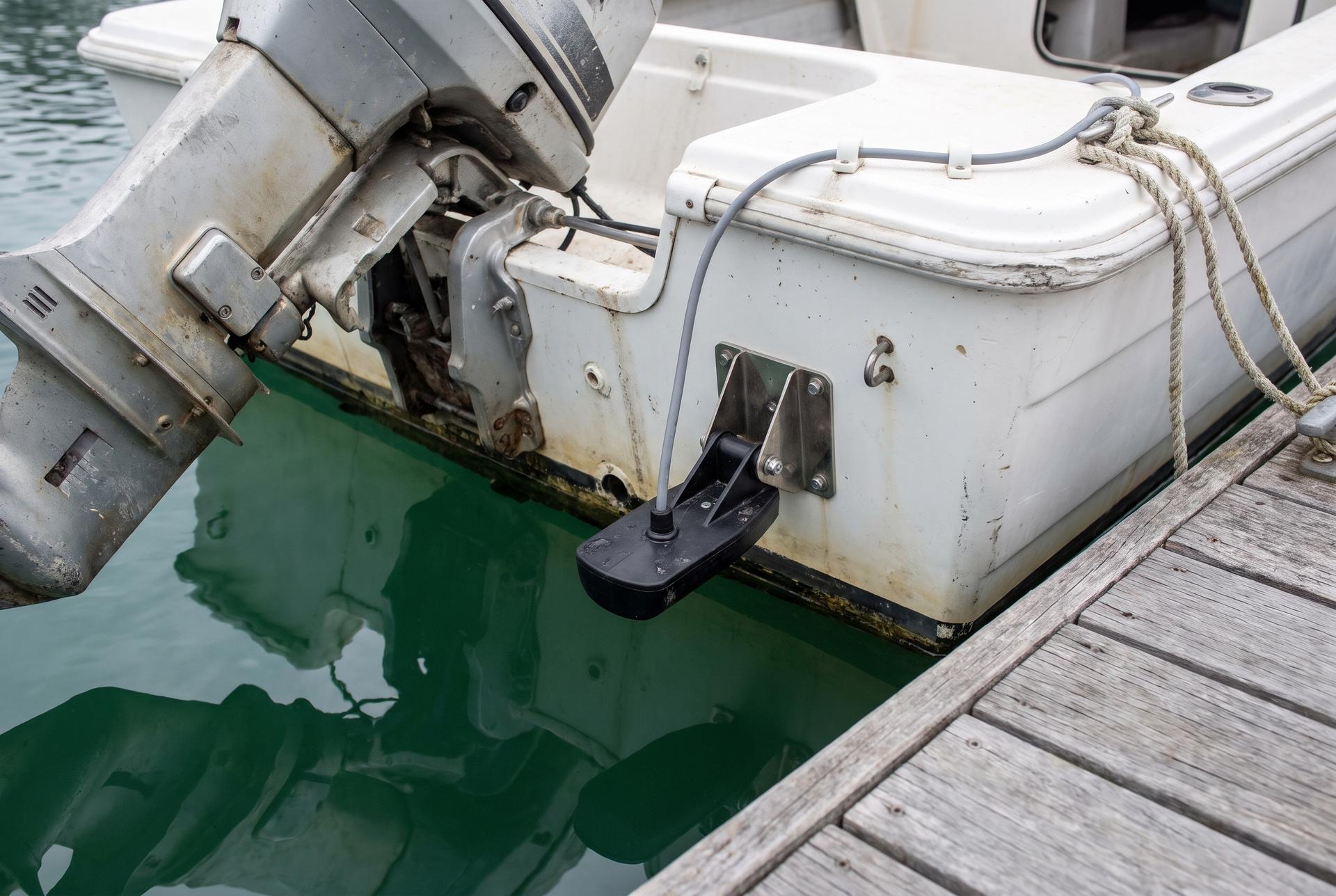
Trolling speed is not a number you guess. It is a number you measure and then repeat. A speed sensor or a GPS speed readout gives you the figure, and the moment a fish hits you write down the speed, the lure and the amount of line out. That is the whole method. A thru-hull speed and temperature transducer reads speed through the water, which is what the lure experiences, while GPS reads speed over ground. In current they are different, and speed through the water is the one that controls how a lure swims.
Species prefer different speeds and the useful range is wide, so there is no single right figure to quote. Instead, work in a loop: pick a speed, run it long enough to prove it, then change it by a small step and run again. Lures tell you when the speed is wrong. A diving plug that rolls on its side is going too fast, and one that wobbles lazily with no rhythm is going too slow.
Lure choice follows depth. A diving trolling lure with a long lip pulls itself down to a set depth on its own and holds there as long as speed is steady. These are the simplest way to fish a known depth behind an electric motor, because the motor gives the steady speed they need. GearPort stocks Rapala X-Rap Magnum 30 plugs, which are built around a large diving lip and heavier saltwater hardware.
Lead core line is the other way down. It is a braided or dacron sheath around a lead wire, so it sinks on its own, and metered versions change colour every ten yards so you can count exactly how much is out and repeat the depth on the next pass. The Sufix Performance Lead Core on the shelf is an 18 lb, ten-colour, 200 yard spool. Lead core is fished off a long rod on a line-counter style setup, with a monofilament or fluorocarbon leader between the lead and the lure.
Rigging the motor: wiring, breakers and the battery behind it
A trolling motor is one of the biggest DC loads on a small boat. It draws tens of amps at full output, and it does it through cable that often runs the length of the hull. That combination is why trolling motor wiring gets its own treatment rather than being tacked onto the accessory panel.
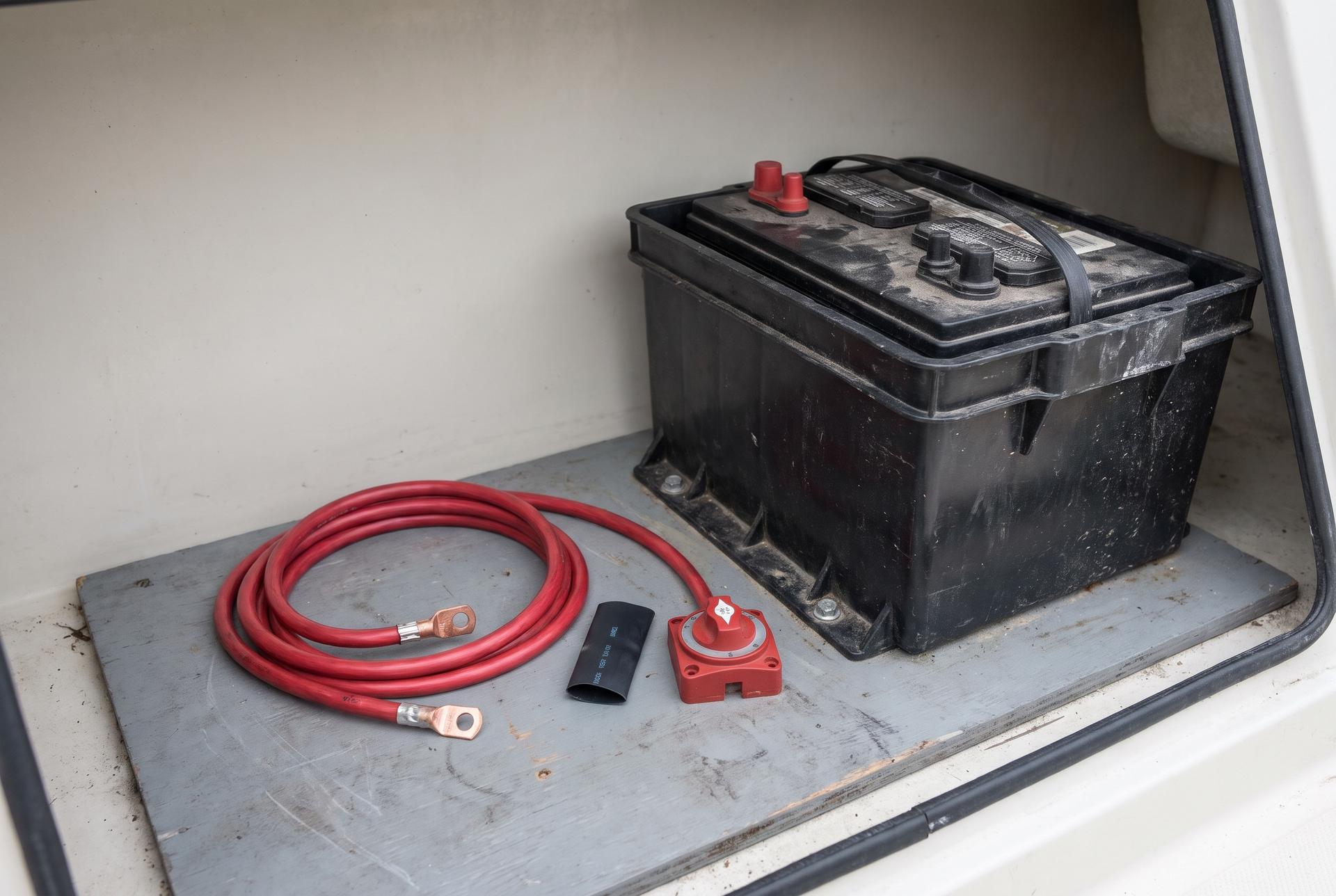
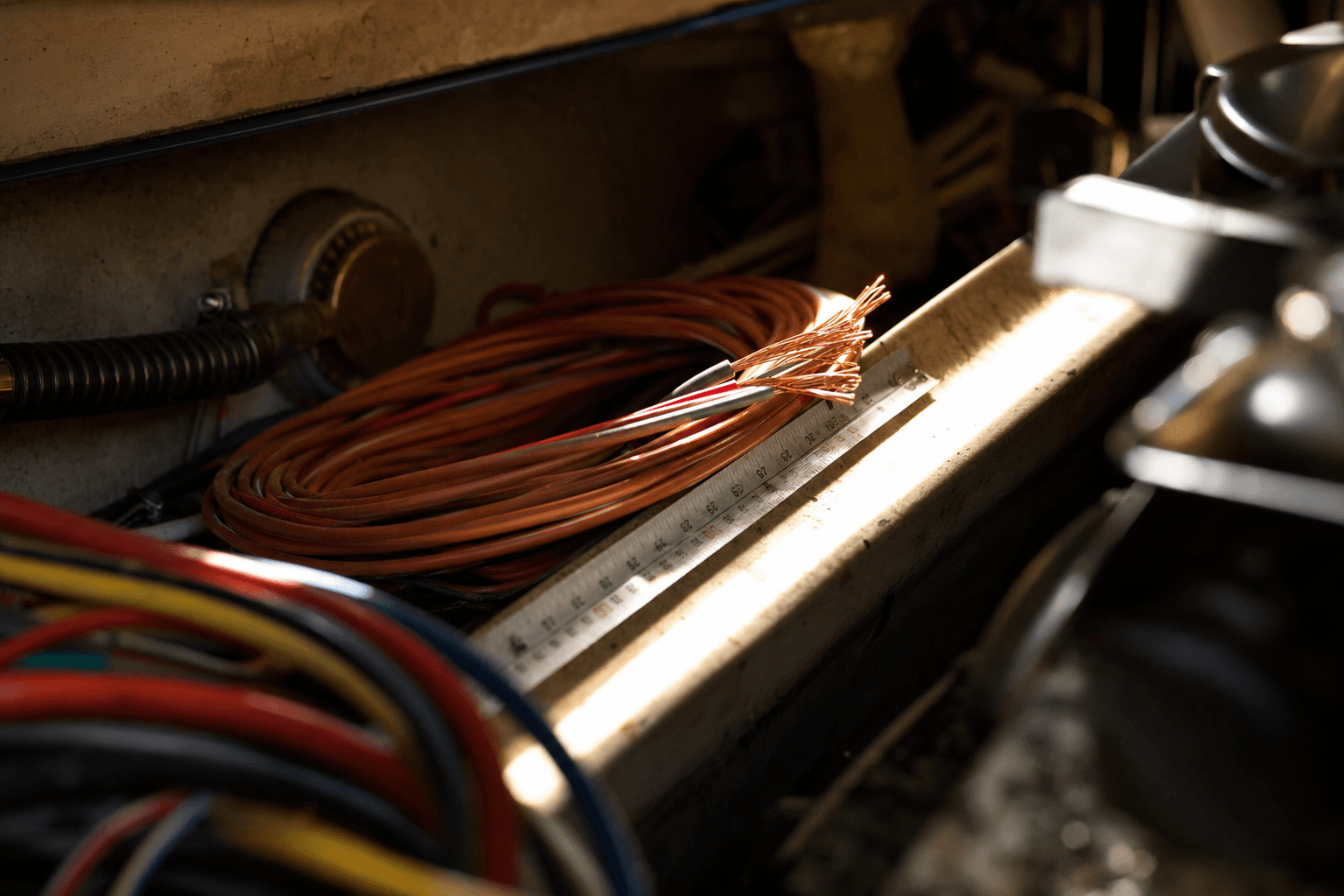
Two rules cover most of it. First, size the cable for voltage drop over the round trip, not just for the current. Undersized cable costs you thrust, gets warm, and wastes battery. The marine wire size chart guide gives the gauge for a given current and run length. Second, protect the circuit at the battery end, as close to the positive terminal as practical, so a chafed cable cannot turn into a fire.
For protection, a resettable circuit breaker is the usual choice over a fuse, because you can reset it on the water and because it doubles as a manual disconnect. GearPort stocks Egis Mobile Electric breakers including a 60A continuous panel mount mini breaker with a 42V DC max rating and an IP66 sealed body, working as a 2-in-1 breaker and manual disconnect for DC trolling motor circuits, and a 30A surface mount 285 Series breaker with a manual on and off switch. Pick the rating to suit the motor's stated maximum current draw and the cable you have run, not the other way round.
If you want the motor circuit switched remotely, a high current relay does that job: a small switch current at the helm closes a big contact near the battery. The Egis 901643 is a 12V, 75A SPST relay with built-in diodes. And if you are deciding between one battery, two in series or a dedicated bank, read the trolling motor battery guide rather than guessing, because the series and parallel wiring is where mistakes get expensive.
Locks, mounts and hardware that keep the motor on the boat
A trolling motor is one of the easier things to steal off a boat, especially a quick-release bow mount sitting on a trailer overnight. A dedicated trolling motor lock secures the motor to its bracket so the quick release cannot be operated. The Sea Swivel Sea Secure lock in stock is machined from Grade 5 titanium, so it does not rust, and it is made to fit Power Pole Move PV and Move Offshore PV quick-release brackets. Locks are bracket specific, so check your bracket model before ordering any of them.
On the water, the thing that keeps a motor attached is bolt tension and backing. A bow mount's bolts pull on deck laminate that was not always designed for that load, so a backing plate spreads it. On a transom mount, the clamp screws loosen with vibration, and a safety lanyard from the motor shaft to a cleat is cheap insurance if one lets go.
Accessory mounting is the other half. Rod holders have to sit where a trolled rod clears the motor and the gunwale, and where you can reach it fast. Track and ball mount systems make that adjustable instead of permanent. The Scotty 152 is a ball mounting system with a gear-head adapter and a side deck mount. The Scotty 257 triple mounting board has three positions for rod holders, fish finders or GPS units.
Finally, think about what the motor shares its space with. Anodes, bilge fittings and transducer brackets all compete for room on a small transom. Lay the parts out dry before drilling anything, because a transducer mounted in the propeller wash of a trolling motor reads noise rather than fish.
Fishing the setup: electronics, rod angles and what to add next
Once the motor runs, the electronics decide how well you troll. A fish finder with a clean transducer install shows you depth, bottom hardness and bait, and lets you keep a lure in the band the fish are using. Mounting matters more than the screen: the transducer needs undisturbed water and the display needs to be readable from the seat you actually fish from. The fish finder mounting guide covers both, including kayak installs.
Rod placement is the next thing to sort. Spread the rods so lines do not cross on a turn. On a small boat that usually means one rod off each quarter and one straight back, with the outside rods angled low and the middle rod high. Use holders that hold the rod firmly, because a trolled rod takes a constant pull and a hit arrives without warning.
Keep a log. Speed, line out, lure, depth, water temperature and the time of day. Three trips of notes beats a season of guessing, and it is the main reason experienced trollers catch fish consistently in water they have fished before.
Things worth adding once the basics work: a second battery bank so the electronics do not share with the motor, a speed and temperature sensor if you do not have one, a landing net that reaches past the motor, and spare props. A prop strike on a rock ends the day otherwise.
A short checklist before you launch
Run through this in the driveway rather than on the ramp.
Mount: bolts tight, backing plate in place, clamp screws checked, safety lanyard attached if it is a clamp-on. Shaft set so the propeller stays buried at the depth you fish and can tilt clear for launching.
Electrical: battery charged and secured in a tray, terminals clean and tight, cable runs supported and clear of anything that moves, breaker fitted close to the positive terminal and sized to the motor, connections sealed against spray.
Fishing: line checked for nicks in the last few yards, hooks sharp, lures running true at the speed you plan to use, rod holders positioned and tight, net within reach. Required safety gear aboard and accessible, which the boat safety equipment guide lists in full.
| Area | Check | Why it matters |
|---|---|---|
| Mount | Bolts and clamps tight, lanyard fitted | Vibration loosens clamps over a day of trolling |
| Shaft | Prop submerged in chop, tilts clear for launch | A ventilating prop loses thrust and steering |
| Cable | Gauge sized for the round-trip run, runs supported | Voltage drop costs thrust and warms the cable |
| Protection | Breaker near the positive terminal, rated to the motor | Protects the cable, and gives you a disconnect |
| Battery | Charged, strapped down, terminals clean | A loose battery is a hazard and a bad connection |
| Electronics | Transducer clear of prop wash, display readable | Noise in the wash hides the fish you are looking for |
| Tackle | Lures run true at speed, rods spread, net aboard | Most trolling failures are speed and spread problems |
A pre-launch check, not a standard. Cable gauge and breaker rating should come from the motor manufacturer's figures and the marine wire size chart.
Circuit protection and switching
Breakers and a high-current relay for the motor circuit, fitted close to the battery.
Mounts, holders and motor security
Rod holder mounting systems, a trolling motor lock and speed sensing for the troll.
Common questions
- Can you troll with an electric trolling motor all day?
- You can, if the battery bank matches the draw. Current rises steeply with speed setting, so a day of low-speed trolling uses far less than a day of running at full output. Work out the motor's draw at the setting you actually fish, match it to the battery's usable capacity, and keep a reserve for getting back. Our trolling motor battery guide covers the sizing.
- What size trolling motor does a kayak need?
- Follow the motor maker's thrust recommendation for your loaded weight, including you, the battery and your gear. A kayak is light, so thrust is rarely the limit. Weight, mounting strength and shaft length matter more. Check what your hull is designed to accept, because clamping a motor to an unreinforced gunwale can crack the rail.
- Bow mount or transom mount for trolling?
- A bow mount pulls the boat and holds a line through wind more precisely, and it supports foot pedal and GPS control. A transom mount clamps on, costs less and moves between boats, but you steer it by hand at the stern. For a dedicated fishing hull with deck space, a bow mount. For a jon boat, small skiff or kayak, a transom mount.
- How do I know what speed I am trolling at?
- Measure it rather than guess. A speed and temperature transducer reads speed through the water, which is what the lure feels, while GPS reads speed over ground. In current the two differ. Record the speed, lure and line out whenever you get a hit, so you can repeat the pass. Lures also tell you: rolling means too fast, lifeless means too slow.
- Do I need a circuit breaker on a trolling motor?
- Yes, the motor circuit needs protection, fitted as close to the battery positive terminal as practical so a damaged cable cannot start a fire. A resettable breaker is usually preferred over a fuse because you can reset it on the water and it doubles as a manual disconnect. Size the rating to the motor's maximum current draw and the cable you have run.
- What line should I use for trolling behind an electric motor?
- For a set depth without extra weight, use diving plugs on monofilament or braid. To reach deeper, metered lead core line sinks on its own and changes colour every ten yards so you can count line out and repeat the depth. Fish lead core on a long rod with a mono or fluorocarbon leader to the lure.