 GearPort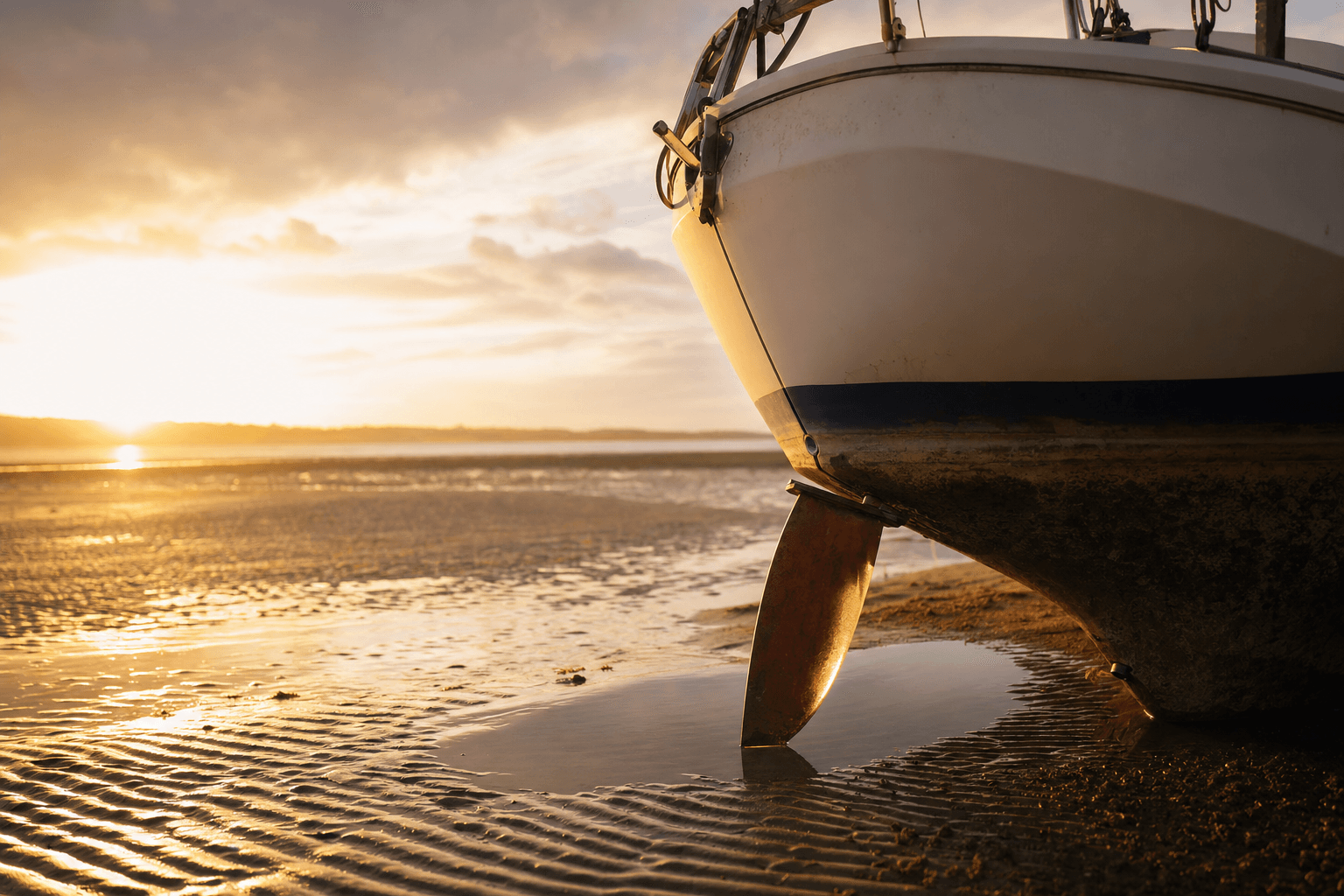
The rudder: how a boat steers, and what wears out
A rudder does not push the back of the boat around. It turns to meet the water flowing past it, generates sideways force in the way a wing generates lift, and that force swings the stern. So it needs water moving across the blade to do anything at all: a boat drifting to a stop steers less and less. On an inboard the propeller sits ahead of the rudder, so a short burst of throttle throws wash across the blade and buys some steering even from a standstill.
Not every boat has one. Outboards and sterndrives steer by pivoting the whole drive, so the propeller thrust does the turning. Inboard boats with a fixed shaft, and sailboats, normally use a rudder. Pod drives, jet drives and steerable thrusters are the exceptions among inboards: like an outboard, they aim the thrust instead.
The parts of a rudder
The blade is the flat surface in the water. The rudder stock, or rudder post, is the shaft it is built around, running up through the hull. Bearings support that stock top and bottom and take the side loads.
Above deck the stock connects to whatever steers it: a tiller directly, or a quadrant or radial drive that a cable or hydraulic ram pulls on.
Where the stock passes through the hull there is a seal or a stuffing arrangement. On a spade rudder that penetration is below the waterline, which makes rudder bearings and their seals a maintenance item rather than a fit-and-forget part.
Transom-hung, skeg-hung and spade
Rudders are named for what holds them up, and on small craft that comes down to three mountings: transom-hung, skeg-hung and spade. What each one means, how to tell them apart, and the rest of the classification are in the types of boat rudders guide, linked below.
How the wheel reaches the rudder or the drive
Mechanical cable steering connects the wheel to the drive or rudder with a push-pull cable. Rotary systems wind the cable around a drum behind the wheel; rack and pinion systems drive it with a toothed rack. Both are common on small and mid-size powerboats and both are serviceable with ordinary tools.
Hydraulic steering replaces the cable with a helm pump, hoses and a cylinder at the drive. It takes the effort out of steering a high-horsepower boat and isolates the wheel from the engine, and it introduces fluid, air and seals as things to maintain.
Tiller steering removes the middle entirely: your hand is on the lever attached to the rudder stock, or on the outboard tiller arm. A tiller extension is simply a lever that lets you sit further forward or outboard and still steer.
What wears out
Play in the bearings. Grab the blade with the boat out of the water and try to move it in ways it should not move. Free movement at the blade that is not matched at the wheel means wear somewhere in between, and it gets worse under load, not better.
A stiff cable. Mechanical steering that has gone heavy is usually a cable that has corroded internally or a fitting that has never been greased. Steering that requires effort is steering you will not use decisively in a tight spot.
Air or a weeping seal in a hydraulic system. Spongy feel, or a wheel that turns without a matching response, means bleeding or a seal, and neither improves on its own.
A wasted rudder anode. Where the blade or the stock is metal sitting in salt water, it is one more metal fitting on a boat full of them, and an anode is what gets eaten instead. A composite blade may have nothing to protect but the stock and its fittings. If there is an anode there, it is doing a job only while there is something left of it.
Steering and tiller hardware
Rotary and rack-and-pinion helm parts, steering and engine control cables, steering fittings and tiller extensions.
Rudder anodes and sensors
Sacrificial rudder anodes in zinc and aluminum, plus rudder angle sensing.
Common questions
- What does the rudder of a boat do?
- It turns to meet the water flowing past it and generates a sideways force, in the same way a wing generates lift. That force pushes the stern around, which turns the boat. It does very little when the boat is not moving through the water.
- Do all boats have a rudder?
- No. Outboards and sterndrives steer by pivoting the entire drive unit, so the propeller thrust does the steering, and pod drives, jet drives and steerable thrusters aim their thrust the same way. Inboard boats with a fixed shaft, and sailboats, use a rudder.
- How do I check a rudder for wear?
- With the boat out of the water, take hold of the blade and try to move it in the ways it should not move: side to side, and fore and aft against the hull. Movement at the blade that is not matched at the wheel or tiller is wear in the bearings or in the linkage between them, and it gets worse under load rather than better. Check the stock where it enters the hull for weeping and corrosion at the same time, and look at the anode if there is one.
- What is the difference between cable and hydraulic steering?
- Cable steering pushes and pulls a physical cable from the wheel to the drive, either wound on a rotary drum or driven by a rack. Hydraulic steering uses a pump at the helm, hoses, and a cylinder at the drive, which reduces effort on higher-horsepower boats and adds fluid and seals to maintain.
Sources
- Nigel Calder, Boatowner's Mechanical and Electrical Manual, International Marine, on steering systems, rudder bearings and stock seals
- Dave Gerr, Boat Mechanical Systems Handbook, International Marine, on rudders and steering gear