 GearPort
Navigation light rules, and how to buy lights that meet them
Navigation lights are one of the purchases on a boat where the specification is set by regulation rather than by preference. The Navigation Rules set what each light covers, how far it must be seen, and which combinations are allowed, and a fitting either meets that or it does not.
The figures below are the ones the rules state, not a manufacturer's summary. The arcs come from Rule 21, the visibility ranges from Rule 22, and the alternative arrangement a small power-driven boat may use from Rule 23(d), as adopted in the US Inland Navigation Rules at 33 CFR part 83. Each rule is listed in the sources at the end of the page.
The four lights and what each one covers
Rule 21 defines each light by its color and by the arc of the horizon it covers. Those definitions are the vocabulary the rest of the rules are written in.
A masthead light is a white light showing over an arc of 225 degrees, centred on straight ahead so it covers 112.5 degrees to each side. Despite the name it does not need to be on a mast.
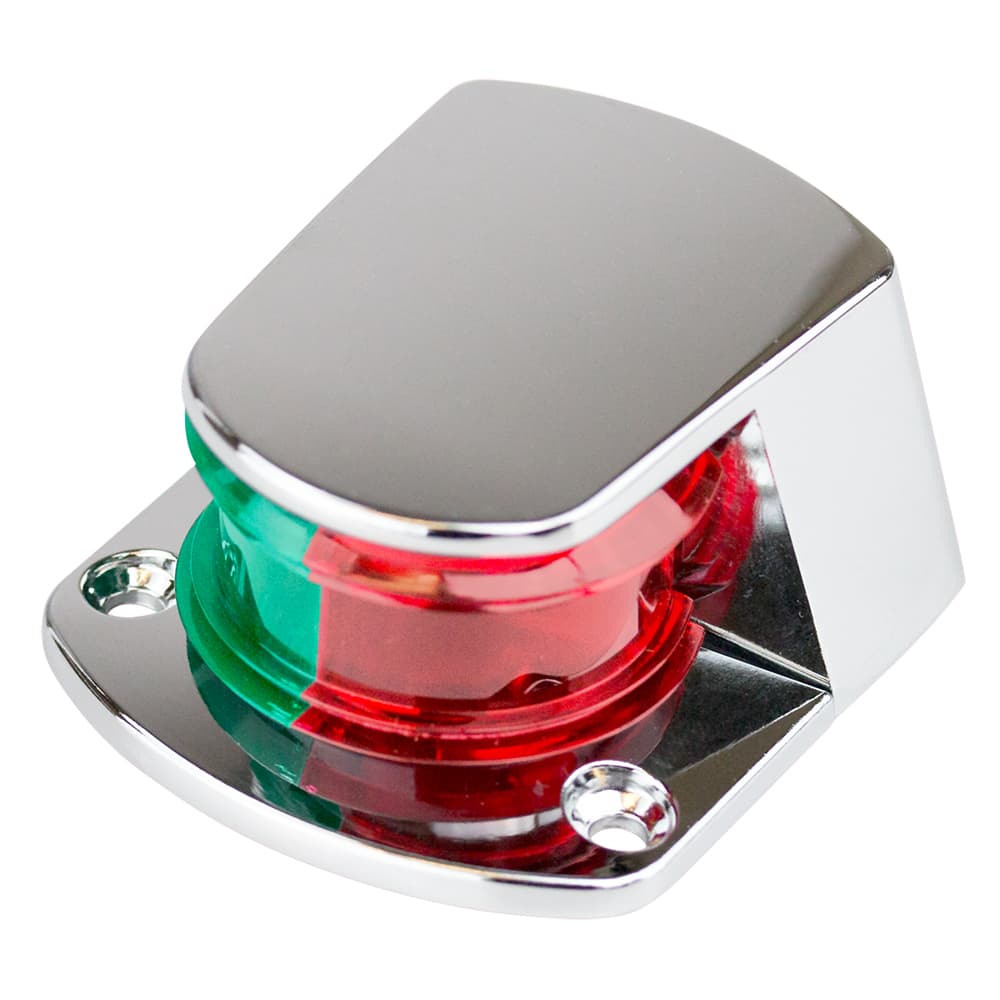
Sidelights are red to port and green to starboard, each showing over 112.5 degrees, from straight ahead to just behind the beam on its own side. On smaller boats the pair is often combined into one fitting at the bow, sold as a combination or bi-color light.
A sternlight is white and shows over 135 degrees, centred on straight astern.
An all-round light shows an unbroken light over 360 degrees. All-round lights come in white, red, green and yellow depending on the signal the rules call for, and the one a small boat carries is white: it is what you display at anchor, and on small powerboats it is also the light that can replace two others.
Read together, those arcs are how another skipper works out your heading in the dark. Red and green together means you are coming toward them. A single red means you are showing your port side. White alone means they are looking at your stern.
How far each light must be visible
Rule 22 sets the minimum range at which each light must be visible, and it sets it by vessel length. For a vessel of less than 12 metres, which is under about 39 feet and covers most of what we sell lights for, the rule requires: masthead light 2 nautical miles, sidelights 1 nautical mile, sternlight 2 nautical miles, all-round light 2 nautical miles.
Fittings are commonly marked 2NM or 2 miles. That marking is the thing to look for, because how bright something appears on a bench says nothing about the range it is rated for.
The ranges step up with length. Under Rule 22 a vessel of 12 metres or more but less than 50 metres needs a masthead light visible at 5 nautical miles, or 3 nautical miles if the vessel is less than 20 metres, with sidelights, sternlight and all-round light at 2 nautical miles. A vessel of 50 metres and over needs 6 nautical miles for the masthead light and 3 nautical miles for the others. Over 12 metres, read Rule 22 for your length rather than assuming a small-boat fitting is enough.
What a boat under 12 metres may substitute
Rule 23(d) allows a power-driven vessel of less than 12 metres, in place of the masthead light and sternlight arrangement otherwise prescribed for a power-driven vessel under way, to display an all-round white light and sidelights.
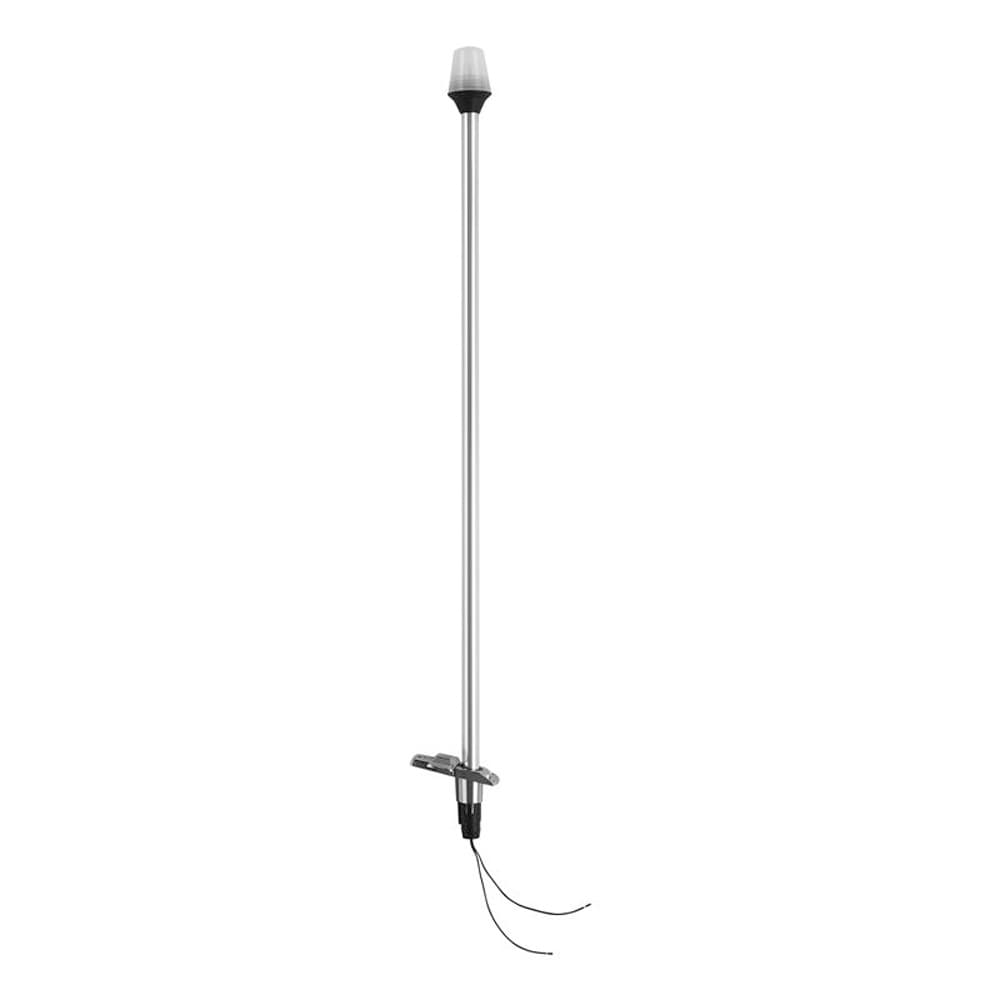
That is the arrangement on a great many small boats: a combination red and green light at the bow, and a white all-round light on a pole aft, high enough to be seen right around the boat.
The pole height is not decoration. An all-round light blocked by a T-top, a bimini, a raised motor or a person standing in the cockpit is not showing 360 degrees, whatever the box said.
Under sail alone a boat is not a power-driven vessel and the arrangement is different. Rule 25 has a sailing vessel under way show sidelights and a sternlight and no masthead light, and on a sailing vessel of less than 20 metres those may be combined in one lantern carried at or near the top of the mast.
At anchor
A vessel at anchor shows an all-round white light where it can best be seen, which is Rule 30 rather than the under-way rules above.
The requirement by vessel size, the black ball day shape, the visibility range and the exemptions for very small boats and for special anchorage areas are covered in the anchor light rules guide.
Buying and installing so it still complies in three years
Buy for the range, marked. A 2NM rating on a fitting for a boat under 12 metres is the specification, not a marketing number. Fittings are also certified for a stated vessel length, often under 12 metres or under 20 metres, so check that alongside the range.
Get port and starboard the right way round. Red is port, green is starboard. Fitted the other way round they tell every other vessel the opposite of your actual heading, which is worth checking on any boat you did not wire yourself.
Watch for lens fade. Years of ultraviolet turn red and green lenses pale. A pale lens is dimmer and reads less clearly as red or green at a distance, so treat it as a maintenance item and replace it rather than polishing it.
Check the arcs after installation, not before. Sit in the dark and walk around the boat, or have somebody else do it. Structure added since the lights were fitted is the usual reason a compliant light is no longer compliant.
Mind the sockets and connections. Nav lights live in spray. Corroded pins and a poor ground are worth checking first when a fitting is dim, flickering or dead, before the lamp or the fitting itself.
Navigation, all-round and anchor lights
Bi-color bow lights, inset and surface-mount sidelights, fold-down and fixed all-round pole lights, and anchor lights from Lumitec, Perko, Attwood, Hella Marine and Sea-Dog.
Common questions
- What navigation lights does a boat need at night?
- A power-driven vessel under way shows sidelights, red to port and green to starboard, plus white lights covering ahead and astern. Under Rule 23(d) a power-driven vessel of less than 12 metres may show an all-round white light together with sidelights instead of a separate masthead light and sternlight.
- How far must boat navigation lights be visible?
- Rule 22 sets the ranges by vessel length. For a vessel under 12 metres the masthead light, sternlight and all-round light must be visible at 2 nautical miles and the sidelights at 1 nautical mile. Larger vessels have longer requirements.
- What arc does each navigation light cover?
- A masthead light covers 225 degrees, each sidelight covers 112.5 degrees, a sternlight covers 135 degrees, and an all-round light covers 360 degrees. Those are the definitions in Rule 21.
- Which side is red and which is green?
- Red marks the port side and green marks the starboard side. Fitted the wrong way round, the lights tell other vessels the opposite of the direction you are actually heading.
Sources
- Navigation Rules (COLREGS as adopted in the US Inland Navigation Rules, 33 CFR part 83), Rules 21 to 25: the lights vessels carry under way and what each one is
- Rule 21, 33 CFR 83.21: definitions of the masthead light, sidelights, sternlight and all-round light, and the arc each covers
- Rule 22, 33 CFR 83.22: minimum visibility range for each light, by vessel length
- Rule 23(d), 33 CFR 83.23: the all-round white light and sidelights alternative for a power-driven vessel of less than 12 metres
- Rule 25, 33 CFR 83.25: lights for sailing vessels under way and vessels under oars
- Rule 30, 33 CFR 83.30: lights and shapes for a vessel at anchor