 GearPort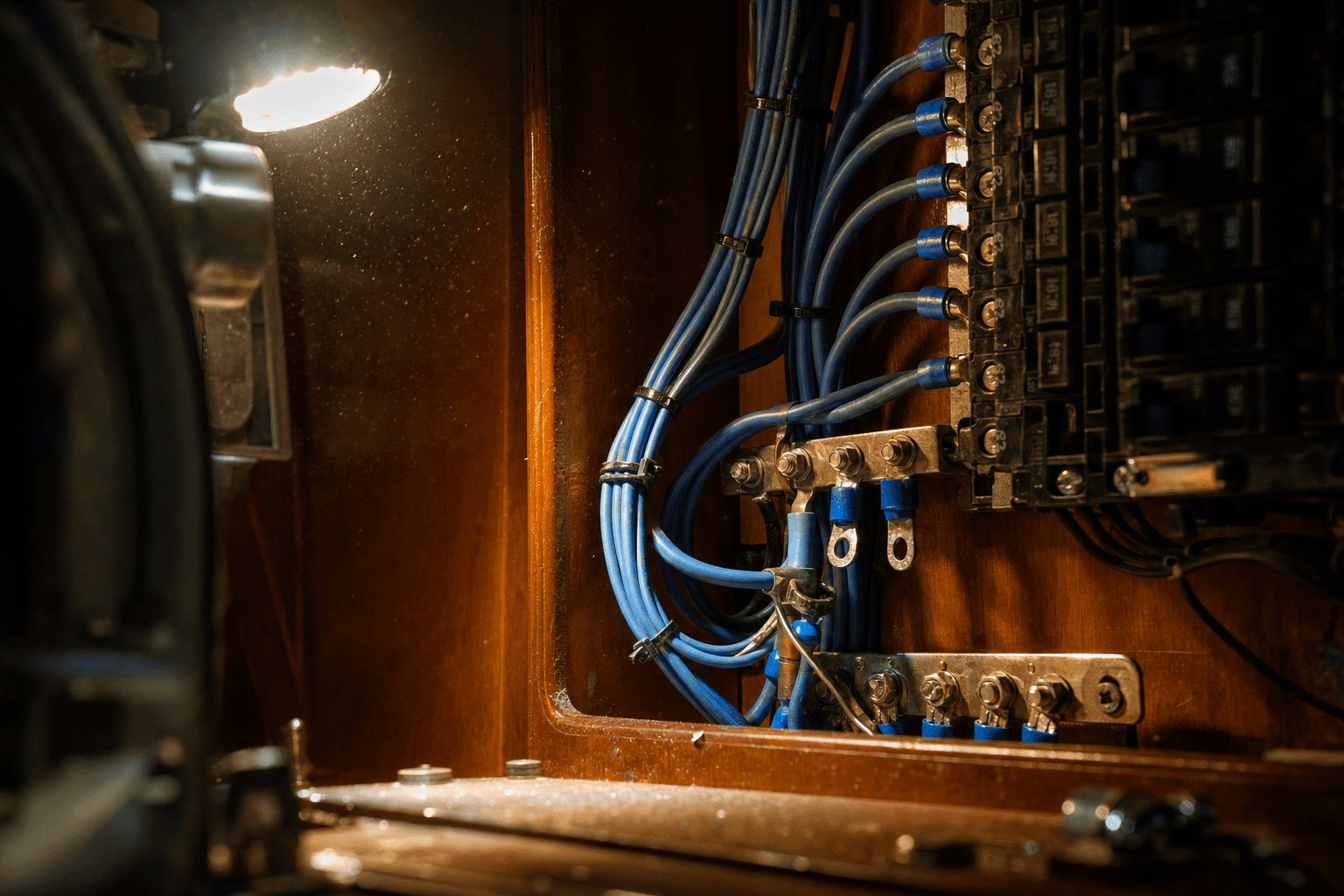
Marine wiring: what to use, how to size it, how to protect it
Most electrical faults on a boat trace back to a connection rather than a component. Salt air, vibration and damp get into a joint, resistance climbs, and something works intermittently for a season before it stops. Wiring a boat well is mostly about choosing the right wire and then terminating it so water cannot get in.
The three decisions that matter are the wire itself, its size, and what protects it. Everything else is workmanship.
Why marine wire is different
Tinned copper. Marine-grade wire has each copper strand plated with tin. Bare copper corrodes from the cut end inward, wicking green up under the insulation where you cannot see it; tinned strands resist that for years. This is the single biggest difference between marine wire and the automotive wire that looks identical on the shelf.
Finely stranded. Marine wire uses many thin strands rather than a few thick ones, so it tolerates constant vibration and tight routing without work-hardening and breaking. Solid wire belongs in a house, not a boat.
Rated insulation. Marine primary wire and boat cable are built to a published construction and temperature rating, commonly 600 volts and 105 degrees Celsius dry with a lower wet rating, typically 75 degrees Celsius. The rating is printed on the jacket, so read it rather than assuming.
Colour convention. Wire is sold in a standard set of colours so a circuit can be traced years later. ABYC E-11 sets out the DC colour code, with red for positive and yellow for DC negative, yellow rather than black so a DC negative is not mistaken for an AC conductor. Black was used for DC negative for decades and is still common on older boats, which is exactly why the yellow convention exists. Whatever scheme you adopt, use it consistently, because the person tracing it later may be you.
Duplex and triplex cable carries two or three insulated conductors in one sheath. It is the tidy way to run a circuit to a light or a pump: one cable, both conductors, jacket protecting them.
Sizing wire: voltage drop, not just current
Two questions decide gauge. Can the wire carry the current without overheating, and will the voltage still be adequate at the far end? On a boat the second question usually sets the size, because runs are long and 12 volts does not have much to give away.
Voltage is lost over the whole circuit, so what matters is the round-trip length: out to the device and back to the negative bus, not the one-way distance. ABYC E-11 gives two design targets for how much of that voltage may be lost: 3 percent on critical circuits such as panel main feeds, navigation lights, bilge pumps, blowers and electronics, and 10 percent on general lighting and accessories where slight dimming is the only symptom.
Turning those targets into a gauge is a lookup rather than something to estimate. See the marine wire size chart guide for the tables, the formula behind them and the ampacity check that goes with them, and when a result sits between two sizes, take the larger.
One consequence worth internalising: a device that works on the bench and underperforms on the boat is often starved by its wiring rather than faulty. Bilge pumps are the usual example, and the bilge pump sizing and wiring guide covers the other reasons one moves less water than its label suggests.
Circuit protection, and where it goes
A fuse or breaker exists to protect the wire, not the device. Size it to what the conductor can safely carry, so the wire is not left as the weakest link in the circuit.
Position is specified, not optional. ABYC E-11 puts overcurrent protection within seven inches of the point where the conductor connects to its source of power, extended to 40 inches where the conductor is contained throughout that length in a sheath or enclosure, and to 72 inches for a conductor connected directly to a battery terminal when it is likewise contained in a sheath or enclosure for the whole run. Engine cranking conductors are treated separately again, so check the standard rather than assuming one distance covers every cable at the battery. The reasoning is simple: everything upstream of the fuse is unprotected, so that length should be as short as practical.
Fuse blocks and breaker panels put all of this in one place, labelled, with each circuit protected on its own. Busbars give the negative side the same discipline instead of a stack of ring terminals sharing one stud.
A battery switch is what lets you isolate the system. The exception worth remembering is the automatic bilge pump, which is commonly wired ahead of the switch so it can still run with the switch off, and which therefore needs its own protection at the battery. The bilge pump sizing and wiring guide covers how that circuit is arranged.
Connections that survive a bilge
Crimp, do not twist. Wire nuts and twisted-and-taped joints have no place on a boat. A properly crimped terminal is a mechanical bond over the full barrel, and it needs the right crimper rather than pliers.
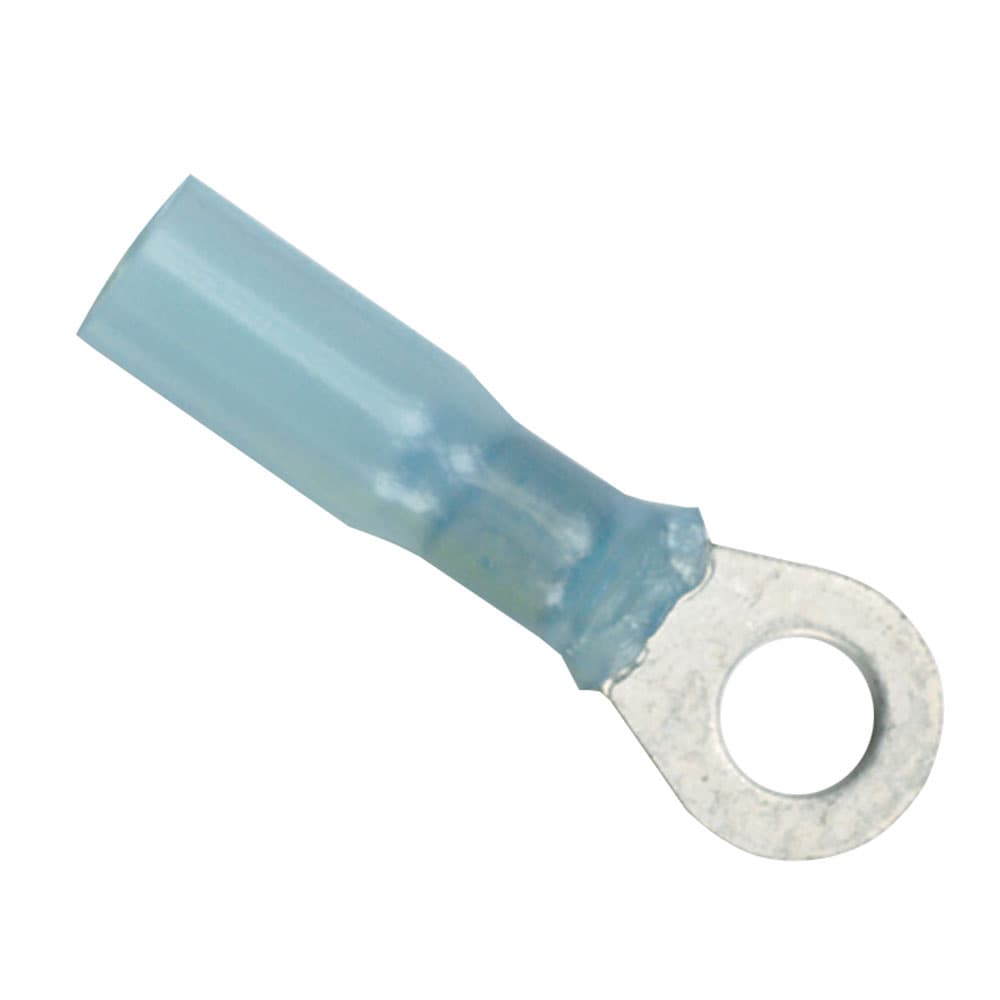
Adhesive-lined heat-shrink terminals are the standard for anywhere that can get damp, which on a boat is everywhere. The shrink seals against the insulation and the glue seals the barrel, so moisture cannot wick into the strands.
Support the run. Cable should be secured at regular intervals so it cannot saw against a bulkhead or hang on its own terminals, and it should be routed as high as practical, away from standing water.
Leave a drip loop where a cable enters a fixture from above, so water runs off rather than following the wire into the housing.
Label both ends. Ten minutes with a label maker at installation saves an afternoon of continuity testing later.
Finally: do not add an accessory to whatever circuit is nearest. That habit is how a wiring loom becomes an undocumented puzzle. Give it its own protected circuit and write it on the panel.
Tinned marine wire and cable
Ancor, Sea-Dog and Pacer tinned copper primary wire in the standard colours, plus duplex and triplex cable and battery cable.
Heat-shrink terminals, lugs and connectors
Adhesive-lined heat-shrink ring terminals and butt connectors, tinned copper lugs for heavy cable, and the crimpers that do it properly.
Fuse blocks, breakers and busbars
Blue Sea, BEP and Sea-Dog circuit protection: fuse holders and blocks, panel breakers, and busbars for the negative side.
Common questions
- Can I use automotive wire on a boat?
- You should not. Marine wire is tinned so the copper resists the corrosion that wicks up bare strands under the insulation, and it is more finely stranded so it tolerates vibration. Automotive wire looks the same on the shelf but is not built for a damp, salty environment.
- How do I size wire for a boat?
- Size it for voltage drop as well as current, and use the round-trip length of the circuit rather than the one-way distance. ABYC E-11 sets design targets of 3 percent voltage drop on critical circuits such as navigation lights, bilge pumps and electronics, and 10 percent on non-critical ones. The gauge for a given current and length is a lookup: the marine wire size chart guide has the tables.
- What does the fuse protect, the device or the wire?
- The wire. Size overcurrent protection to what the conductor can safely carry, so the wire is not left as the weakest link in the circuit.
- How close to the battery does a fuse have to be?
- ABYC E-11 puts overcurrent protection within seven inches of the point where the conductor connects to its source of power. That extends to 40 inches where the conductor is contained throughout that length in a sheath or enclosure, and to 72 inches for a conductor connected directly to a battery terminal when it is likewise contained in a sheath or enclosure for the whole run. Engine cranking conductors are treated separately, so check the standard for those. Everything upstream of the fuse is unprotected, which is why that run is kept short.
- Are crimped or soldered connections better on a boat?
- A correctly crimped connection in an adhesive-lined heat-shrink terminal is the marine standard. It is a full-barrel mechanical bond and the shrink and glue seal out moisture. Twisted joints and wire nuts do not belong on a boat.
Sources
- ABYC E-11, AC and DC Electrical Systems on Boats: the DC conductor colour code, the 3 percent and 10 percent voltage drop design targets, and section 11.10 on overcurrent protection, including the 7 inch placement rule, its 40 inch and 72 inch exceptions for sheathed conductors, and the separate treatment of engine cranking conductors
- UL 1426, Cables for Boats: the construction and the dry and wet temperature ratings marine primary wire and boat cable are built to