 GearPort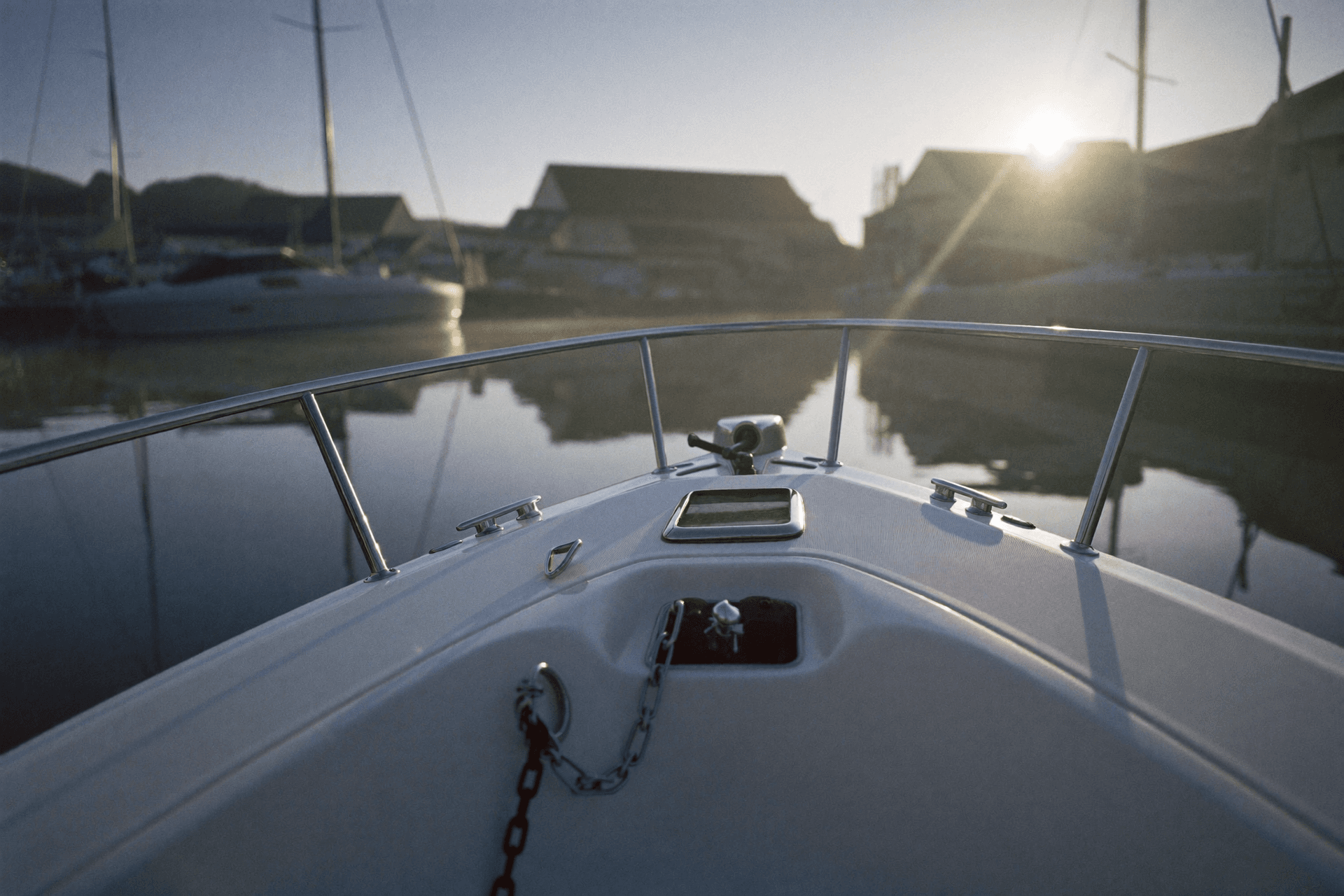
The bow: what is up front and what it has to survive
The bow of a boat is the front end, the part that cuts through the water first. The opposite end is the stern, at the back. Facing the bow from anywhere on board, port is on your left and starboard on your right.
The bow is pronounced to rhyme with cow, not with low, and it is spelled bow, not bough. Forward, or fore, means toward the bow. Aft means toward the stern. Those four words cover most of the directions anybody will shout at you on a boat.
Beyond the definition, the bow is a working end. Its shape decides how the boat meets a wave, and its hardware decides whether you can stop the boat drifting once the engine is off. Everything up front is either structural, part of the anchoring system, or a light other boats need to see, and all three live in the wettest place on the boat.
What the bow of a boat is
The bow is the forward end of the hull, the end that points the way the boat is going under normal power. On most hulls it is the narrowest part of the boat seen from above, and it rises higher out of the water than the middle does, so spray and waves are deflected outward and down rather than straight onto the deck.
The stern is the opposite end, the back. Between them, port is the left side and starboard the right side when you are facing the bow. Those sides do not change with where you happen to be standing, which is the whole point of having the words.
Almost every boat has a bow, from a kayak to a container ship. What changes is how much hardware lives there. A small tiller boat may have nothing up front but a stem fitting and a cleat. A cruiser carries an anchor, a roller, a windlass, a rail, a locker and a navigation light, all in a few feet of deck.
Bow, bough, stern and aft: the wording people get stuck on
Bow rhymes with cow. It is pronounced like the bow you take at the end of a performance, not like the bow of a ribbon, and it has nothing to do with a bough, which is a tree branch. If you have seen boat bough written down, it is a misspelling of boat bow.
Bow versus stern is simply front versus back. Bow versus aft is a slightly awkward pairing, because bow is a place and aft is a direction, but in practice people use it to mean the same front and back split. The tidy version is bow and stern for the two ends, forward and aft for the two directions.
A few related words come up at the front of a boat. Ahead means in front of the boat. Head to sea describes a boat pointed into the waves. Abeam means off to the side at a right angle to the centreline. None of them replace bow, but they are often in the same sentence as it.
Parts of the bow, named one by one
Here is the hardware you will find up front, in the order you would meet it walking from the deck down to the waterline.
Stem: the leading edge of the bow itself, the line running from the deck down to the bottom of the hull. It is the structural spine of the front end, and on a wooden boat it is a shaped timber or a laminated assembly.
Bow eye: a loop through the stem below deck level, commonly stainless or galvanised steel. Its exact position varies with the hull and the trailer setup. It is what a trailer winch strap hooks to. Whether it may also serve as a towing point depends on how the builder rates it, so check the manual before you pull on it.
Pulpit: a platform or railed frame extending forward past the stem, common on boats set up for anchoring or fishing. It carries the anchor clear of the hull and gives you somewhere to stand.
Bow rail: the rail around the forward edge of the deck, there to stop a person going over the side. Anchor locker: the recess the anchor and rode drop into, usually with a drain in the bottom. Bow roller: the grooved roller the anchor rode runs over so the chain is not sawing into the deck edge.
Cleats are the horned fittings you tie a line to. Chocks are the smooth fairleads that guide a line over the edge without chafing it, so a dock or anchor line passes through a chock on its way to a cleat. Some boats also carry a bow thruster, a small sideways propeller in a tube through the hull, used to push the bow across when docking.
| Part | What it is | What it does |
|---|---|---|
| Stem | Leading edge of the hull | Splits the water and carries the structure of the bow |
| Bow eye | Metal loop through the stem | Trailer winch attachment point, sometimes rated for towing |
| Pulpit | Platform forward of the stem | Holds the anchor clear of the hull and gives working space |
| Bow rail | Rail around the foredeck | Keeps crew on the boat |
| Anchor locker | Recessed well in the foredeck | Stows the anchor and rode, drains overboard |
| Bow roller | Grooved roller at the stem head | Lets the rode run out and back without chafing the deck |
| Cleat | Horned tie-off fitting | Takes dock, anchor and tow lines |
| Chock | Smooth fairlead at the deck edge | Leads a line over the edge without chafe |
| Bow thruster | Transverse propeller in a tube | Pushes the bow sideways at low speed |
Not every boat has every fitting. Pulpits, rollers, windlasses and thrusters are common on larger or anchoring-focused boats and absent on many small ones.
How bow shape changes the ride
The shape of the bow is the first thing that decides how a boat feels in a chop. A fine, sharp bow with a lot of V in the forward sections slices into a wave instead of slapping it, which gives a softer ride at speed but less buoyancy right at the front. A fuller, blunter bow carries more volume forward, rides higher over a wave and stays drier, but it tends to pound when the boat is driven hard into a short sea.
Flare is the outward curve of the topsides as they rise toward the deck. More flare pushes spray outward and away, and adds buoyancy as the bow drops into a trough, which is what stops a fine bow burying itself. Rake is how far the stem leans forward from vertical. A raked stem lengthens the waterline as the boat heels or dives and gives the bow more time to lift.
A plumb, near-vertical stem does the opposite: it maximises waterline length for a given overall length, which raises hull speed potential on a displacement hull, and it is common on modern cruisers and workboats. A reverse or inverted bow goes further still, leaning aft at the top.
This is also why weight distribution matters up front. A waterlogged anchor locker, a heavy chain pile and two people sitting on the bow all push the front of the boat down, and a bow that is already down is the one that stuffs into the back of a wave. The hull shape only does its job if you let it float the way it was drawn.
Bow and navigation lights
The lights that live at the bow are the sidelights, red to port and green to starboard. On smaller boats they are often combined into a single fitting at the stem and sold as a combination bow light. The point of the colours is that another skipper can work out which way you are heading, and whether they are looking at your left side or your right.
The arcs, visibility ranges and small-boat alternatives are set out in our navigation light rules guide, which is the page to read before buying anything. The same rules cover the white stern light and the all-round light, which are not bow fittings but are part of the same set.
The practical failure here is rarely electrical. It is the lens. Years of sun turn a red or green lens pale, and a pale lens is both harder to see and less clearly red or green from a distance. Polishing does not bring the colour back, so replace the lens or the fitting.
The second common fault is the ground return and the terminals behind the fitting, which sit in the wettest part of the boat. Corroded crimps dim a light long before they kill it, and a dim light looks fine from the helm and poor from a mile away.
| Light | Colour | Where it sits |
|---|---|---|
| Sidelight, port | Red | Port side, or one half of a combination fitting at the bow |
| Sidelight, starboard | Green | Starboard side, or the other half of the combination fitting |
| Combination bow light | Red and green | At or near the stem on smaller boats |
Colours per Rule 21(b), 33 CFR 83.21, US Inland Navigation Rules. Which lights your boat must show, and their arcs and ranges, depend on its size and what it is doing.
Ground tackle: how the anchoring system works
Ground tackle is the collective name for the anchor and everything connecting it to the boat. The line and chain together are the rode. The anchor holds by setting into the bottom rather than by weight alone, so both the pattern and the size matter: pick the type for the bottom you anchor in, and the size from the maker's table for your boat's length and weight.
A fluke anchor, often referred to by the Danforth brand name, buries its two flat flukes in sand and mud and stows flat. A plow or scoop anchor is designed to set in a wider range of bottoms and to reset if the pull direction changes. A grapnel hooks rock and structure. A mushroom anchor holds a small boat in soft mud and is really a mooring weight.
The chain between anchor and line does two jobs: it resists abrasion where the rode drags on the bottom, and its weight helps keep the pull on the anchor horizontal, which is what lets an anchor bury rather than break out. That horizontal pull is why you let out far more rode than the water is deep. Scope is the ratio of rode paid out to the vertical distance from the bow roller down to the bottom, which is the depth of water plus the height of the roller above it. More scope means a flatter angle at the anchor, and too little scope is a common cause of dragging.
A windlass is the winch that raises the anchor, controlled by a foot switch or a remote. The rode runs from the windlass over the bow roller, and on most boats a short length of chain or a snubber takes the load off the windlass gypsy once the anchor is set.
What goes wrong at the bow
Cleats pulling out. A cleat is only as strong as what is behind it. Through-bolted with a backing plate underneath, the load spreads into the deck instead of into a few screw threads, which greatly reduces the chance of pull-out. Screwed into a thin deck, it will eventually tear out, usually while a line is loaded.
A blocked anchor locker drain. The locker fills with water, mud and weed, the drain clogs, and that weight sits well forward, which changes how the boat rides. Clear it, and check that the drain actually exits somewhere useful rather than into the bilge.
Chafe. A line working over an edge without a chock or a chafe guard wears through faster than most people expect, and chafe failures show up under load, which is exactly when you need the line.
Corrosion at the bow eye. It sits low, gets constant spray, and is frequently a different metal from the fastenings around it. Look for rust weeping from around the backing nut and for any movement when you lean on it. A bow eye that has started to move is a trailering problem before it is anything else.
What to check before buying bow hardware
Measure the deck thickness and look underneath before ordering a cleat or a chock. If you cannot get a hand to the back of the fitting, you cannot through-bolt it, and that changes which fitting is sensible.
Match the metal to what is already there. stainless is the usual choice for deck fittings, commonly 304 or 316, with 316 preferred where there is salt water exposure, galvanised steel is common on trailer hardware and working boats, and mixing metals in a wet joint invites corrosion. Where you must mix, isolate and bed the joint with a marine sealant.
For anchoring gear, start with the anchor size table from the maker for your boat's length and displacement, then size the rode and the roller to the anchor rather than the other way round. A roller that is too narrow for the shank will jam the anchor at the worst moment.
For lights, check the mount before the fitting. Flush, surface, pole and rail mounts are not interchangeable, and a replacement that does not match the existing holes means filling and re-bedding the deck.
Bow and navigation lighting
Navigation light fittings and the wire behind them.
Deck hardware and bow fittings
Cleat fairleads, shackles, bow stops, boat hooks and thruster parts.
Hull protection and sealant
Keel guards, sealant and adhesive removers for work at the stem.
Common questions
- Which end of a boat is the bow?
- The front end. The bow is the end that points forward when the boat is under way, and the stern is the back. If you are unsure on an unfamiliar boat, the bow is normally the narrower, pointed end and the end that sits higher out of the water. The engine, the rudder and the boarding platform are almost always at the other end.
- What is the difference between the bow and the stern?
- The bow is the front of the boat and the stern is the back. Forward, or fore, means toward the bow. Aft means toward the stern. Standing anywhere on board and facing the bow, port is your left and starboard is your right, and those sides stay the same no matter which way you turn.
- Why is it called the bow?
- The word came into English from Low German and Dutch terms for the shoulder of a ship, the curved forward part of the hull. It is unrelated to a bow and arrow in use, though it is spelled the same, and it is pronounced to rhyme with cow. It is not spelled bough, which is a tree branch.
- What is the bow of a boat for?
- Two things. Structurally it parts the water, so its shape and flare decide how softly the boat meets a wave and how much spray reaches the deck. Practically it is where the anchoring system lives, along with the sidelights, the bow rail and the forward cleats and chocks that take dock and tow lines.
- What is a bow eye for?
- It is the loop through the stem, usually stainless or galvanised steel, that a trailer winch strap hooks to. Whether it may also be used as a towing point depends on how the builder rates it, so check the manual before you pull on it. Either way it is a structural fitting, so corrosion or movement there is worth investigating.
- What is scope when anchoring?
- Scope is the ratio of rode paid out to the vertical distance from the bow roller down to the bottom, which is the depth of water plus the height of the roller above it. More scope means a flatter pull at the anchor, which is what lets it bury instead of breaking out. Too little scope is a common cause of dragging.