 GearPort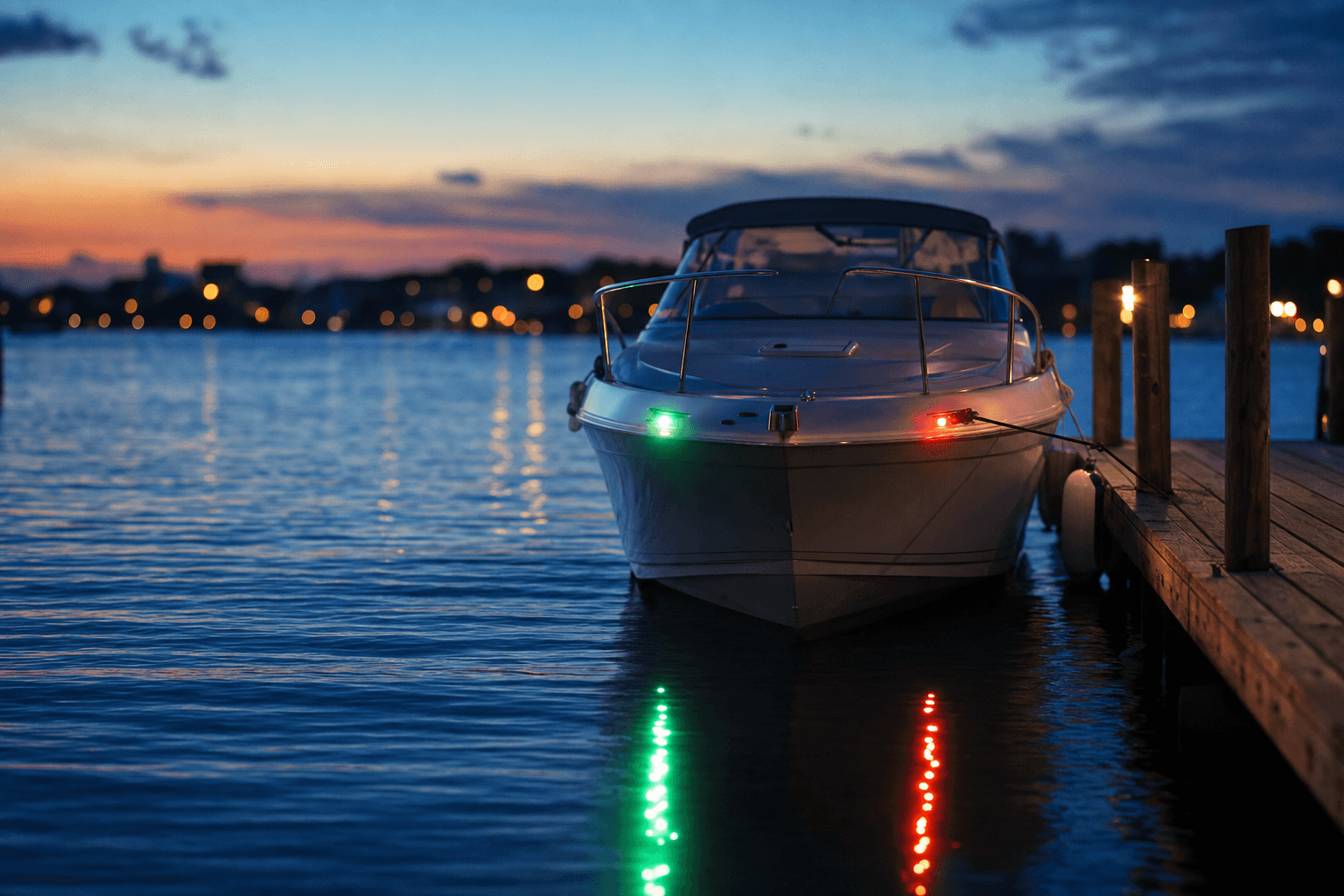
Port vs Starboard: What They Mean and How to Remember Them
Port is the left side of a vessel when you are facing forward, toward the bow. Starboard is the right side. The words stay fixed to the boat, so they mean the same thing whether you are at the helm looking ahead, sitting on the foredeck facing aft, or hanging over the side with a boat hook.
That is the whole point of them. Left and right depend on which way a person happens to be turned, and on a moving boat at night that ambiguity is dangerous. Port and starboard belong to the hull, not to the crew member saying them.
This guide covers the definitions, where the words came from, the memory tricks that actually stick, how the red and green navigation lights line up with each side, and the mix-ups that catch people out. If you are here because you are about to buy running lights, the red one goes to port and the green one goes to starboard, and the detail is further down.
What port and starboard actually mean
Port is the left-hand side of a vessel when you face the bow, the front. Starboard is the right-hand side when you face the bow. The reference point is always the boat itself, facing forward, regardless of where anybody is standing or which way they are looking.
The two other directional words that go with them are bow for the front and stern for the back. Something forward of you on the boat is toward the bow. Something aft is toward the stern. Put those four together and you can describe any position on board without ever using left or right: the port bow, the starboard quarter, amidships on the port side.
These are fixed sides, not relative ones. If you are standing at the stern looking back at the wake, the port side of the boat is still on your right hand, because the boat has not turned around just because you have. That trips up beginners constantly, and it is worth saying out loud a few times until it feels natural.
The same words are also used for direction of movement. Turning to port means turning left from the boat's point of view. A vessel on a port tack under sail has the wind coming over its port side. In every case the boat, not the person, is the thing being described.
Why boaters use these words instead of left and right
Because left and right move with the speaker and port and starboard do not. On a boat, the person giving an instruction and the person receiving it are often facing different directions, sometimes in the dark, sometimes shouting over an engine. "Fender on the left" is a question. "Fender on the port side" is an instruction.
The stakes are highest at night and in close quarters. Docking, anchoring, working a line, or passing another vessel all involve short instructions that cannot be misread. A crew member at the bow facing forward and a helmsman at the wheel facing forward agree on left and right, but a crew member facing aft to handle a stern line does not. The fixed terms remove the guesswork.
The convention also runs through everything else on a boat. Navigation lights, buoyage, the rules of the road, engine numbering on twin installations, tank and battery labelling, and hull and deck drawings all use port and starboard. Once you are reading a wiring diagram or a lighting rule, left and right have stopped being useful words.
Where the terms came from
Starboard comes from Old English steorbord, meaning the steering side. Before the centre-mounted rudder became normal, ships were steered with a large steering oar or board hung over one side of the hull, and it was usually the right-hand side. That side became the steer-board side, which became starboard.
Port is the side a ship could safely put alongside a quay. With the steering oar hanging off the right side, bringing that side against a dock risked crushing it, so the ship turned its other side to the harbour. The older English word for that side was larboard, and the loading or harbour side came to be called the port side instead.
Larboard and starboard sound too similar to be safe when shouted across a deck, which is exactly why one of them had to go. The Royal Navy standardised on port by an Admiralty Order in 1844, and the change spread through merchant shipping in the decades that followed. That is why old novels and ships' logs still contain larboard, and modern ones do not.
None of this history is needed to use the words correctly, but it explains the shapes of them, and the steering-side story is what makes starboard stick in most people's heads.
Simple ways to remember which side is which
Pick one aid and use it consistently. Collecting five of them makes the answer slower, not faster. The aids below all work, and most people settle on one of the first two.
The word-length trick is the one most instructors teach: port and left are the short words, starboard and right are the long ones. Short with short, long with long. It takes no thought once you have used it a few times.
The other reliable one is physical. Hold your left hand up in front of you; the hand on the port side of your body is the hand that points to the port side of the boat when you face forward. Combine it with the colour, red on the left, and you have both the side and the light in one gesture.
| Memory aid | How it works |
|---|---|
| Word length | Port and left are both short words. Starboard and right are both longer. |
| Alphabetical order | Left comes before right in the alphabet, and port comes before starboard. Pair them in that order. |
| Left hand | Facing forward, your left hand is on the port side. Red light, left hand, port. |
| Red port wine | Port wine is red, and the port navigation light is red. Both are on the left. |
| Sailors left port | The crew left port. Left and port go together, and the leftover ship went to starboard. |
| Steering side | Starboard came from the steering board, hung on the right. The other side faced the dock. |
Informal memory aids in common use among boating instructors. They are teaching devices, not rules.
Using port and starboard when giving directions on board
Say the side first, then the object, then the action. "Port bow, fender down" is clearer than a sentence that finishes with the location. On a noisy boat people hear the first two words and act on them.
Combine the fore-and-aft words with the side words to place things precisely. The port bow is the front left area, the starboard quarter is the back right area, and abeam means directly out to the side. If you need a distance, boat crews often use clock bearings relative to the bow, with dead ahead at twelve. Clock bearings and port or starboard say different things, so pick one system per instruction rather than mixing them mid-sentence.
Steering instructions follow the same logic. Turning to port swings the bow left as the boat sees it. If you are relaying an instruction to a helmsman who cannot see what you can see, give the side and the reason: "turn to starboard, crab pot to port."
Two habits are worth building. Repeat back what you heard, so the person giving the instruction knows it landed. And brief any guest crew on the two words before you leave the dock, because the first time somebody hears port under pressure should not be when a line is running out.
Gear that uses port and starboard markings
Anything sold as a pair for a boat is usually labelled by side, and navigation lights are the clearest example. Sidelights are sold either as a matched red and green pair, as individual port or starboard fixtures, or as a single combined unit that shows both sectors.
Matched pairs are the simplest to buy because the colours and mounting style are already sorted. In stock at GearPort there are pairs such as the Perko Vertical Mount Side Lights Model 0254 (Pair), the Sea-Dog Stainless Steel LED Navigation Lights Port and Starboard Pair, and the Hella Marine NaviLED Port and Starboard Navigation Light Pair rated at 2 nautical miles. Hella Marine lists both coloured-lens and clear-lens variants of that pair, so check which one you are ordering if the look matters to you.
Single-side fixtures are sold separately because a replacement is often needed on one side only, or because the two sides mount differently on a given boat. Examples in stock include the Lopolight 301-001 starboard sidelight and the Lopolight Series 301-002 port sidelight, both listed at 2 nautical miles, alongside 1 nautical mile units such as the Lopolight Series 101-001 starboard and Series 101-002 port lights. As a practical matter, fit two lights of the same rating and style on the two sides rather than mixing ratings, and check the navigation light rules guide for what your boat length actually requires.
Combined sidelights put both sectors in one housing, which suits small boats with limited mounting space. The Lopolight 201-004 is listed for vertical mounting against a flat surface such as a mast face, bulkhead, cabin side or pilothouse front, while the Lopolight 201-003-FB and the 1 nautical mile Lopolight 101-003-FB are horizontally mounted units with an FB base. For boats without a 12 volt system, there are portable kits, including the RAILBLAZA NaviPack Portable LED Navigation Light Kit with i360 and iPS lights on an ExtendaPole 1000, and the Attwood PaddleSport and clamp-on kits, which pair a bi-colour bow light with a white stern light.
Common mix-ups and how to avoid them
The most common error is reversing the sides when you are facing aft. Docking, handling a stern line, or backing into a slip all put crew the wrong way round, and the brain quietly swaps the answer. The fix is to fix the reference point before you speak: picture the bow, then decide.
The second is assuming the other vessel's lights describe your situation rather than theirs. A red light is on that vessel's port side, not yours. Getting that backwards inverts your reading of the crossing rule, which is the whole reason the colours exist.
The third is buying lights by colour alone and ignoring the arc and the mounting. The sidelight arcs in Rule 21 depend on the fitting being aimed correctly and on nothing on deck blocking the beam. A red light aimed the wrong way, or a pulpit rail cutting into its arc, does not do the job even though the colour is right.
The fourth is language drift on board. Crews who use left and right for half the trip and port and starboard for the other half create the exact confusion the words were invented to remove. Pick the boat's words and use them for everything, including where the coffee went.
Port and starboard sidelight pairs
Matched red and green sets, so both sides arrive together.
Single-side sidelights
Individual port or starboard fixtures for replacing one side.
Portable and paddlecraft light kits
Battery-powered options for kayaks, tenders and boats without a 12 volt system.
Common questions
- Which side is port on a boat?
- Port is the left-hand side when you face forward, toward the bow. It stays the left side of the hull no matter which way you are standing or looking. If you are facing the stern, the port side is on your right hand, because the sides belong to the boat rather than to you.
- How do I remember port and starboard quickly?
- Use the word-length trick: port and left are short words, starboard and right are long ones. Pair short with short. A second aid is your left hand, which is on the port side of your body when you face forward, and the port light is red, like port wine. Pick one and stick with it.
- Why is it called starboard?
- Starboard comes from Old English steorbord, the steering board. Before centre-mounted rudders, ships were steered by a large oar or board hung over the right side of the hull. That became the steer-board side, or starboard. The other side was turned to the quay for loading, which is where port comes from.
- What colour light is port and what colour is starboard?
- Port shows a red sidelight and starboard shows a green one. Under Rule 21 of the collision regulations, each sidelight shows an unbroken arc of 112.5 degrees, from dead ahead to 22.5 degrees abaft the beam on its own side. Seeing only red means you are looking at that vessel's port side.
- If I see a red light on another boat, who gives way?
- Seeing another power-driven vessel's red light means you are on her port side, so she has you on her starboard side. Under Rule 15 she is the give-way vessel and you are normally the stand-on vessel. If you see her green light instead, she is on your starboard side and you must keep out of the way. Rule 17 still requires the stand-on vessel to act if collision looks likely.
- What happened to larboard?
- Larboard was the older English word for the side now called port. It sounded too much like starboard to be safe when shouted across a deck. The Royal Navy standardised on port by an Admiralty Order in 1844, and merchant shipping followed. That is why larboard appears in older logs and novels but not in modern usage.
- Do port and starboard mean the same thing on aircraft and spacecraft?
- The terms are borrowed from ships, but usage outside the marine world is inconsistent. Aviation use of port and starboard is limited and largely historical, and most modern aviation practice uses left and right. Treat port and starboard as marine terminology, and do not assume another field applies them the same way.
Sources
- COLREGS (International Regulations for Preventing Collisions at Sea, 1972), Rule 21(b), definition of sidelights
- COLREGS Rule 21(b); Rule 23 lights for power-driven vessels under way
- COLREGS Rule 15, crossing situation
- COLREGS Rule 17, action by stand-on vessel
- Admiralty Order of 1844 replacing larboard with port; recorded by the Royal Museums Greenwich and the Oxford English Dictionary entry for larboard
- Oxford English Dictionary, etymology of starboard (Old English stēorbord)
- Oxford English Dictionary, etymology of port (nautical sense) and larboard
- GearPort product listings supplied in the store catalog