Transom savers and trailering support: protecting an outboard on the road
A transom saver is a bar or bracket that runs from the outboard's lower unit down to the trailer, so the tilted motor rests on the trailer frame instead of hanging off the back of the boat. On the road it stops the motor swinging on its tilt system and stops every bump being turned into a lever arm on the transom.
That is the whole job. It does not hold the boat on the trailer, it does not replace tie-downs, and it does not help a transom that is already soft. It is one link in a chain that also includes the winch strap at the bow, the bow safety chain, the transom tie-downs at the back, and the bunks or rollers under the hull. A weak link anywhere in that chain shows up as cracked gelcoat, a loose motor bracket, or a boat that has shifted an inch forward on the trailer by the time you reach the ramp.
GearPort does not stock transom savers, so this guide is about getting the decision right rather than selling you a bar. What the store does carry is the rest of the chain: Rod Saver replacement winch straps, stainless and rubber ratchet transom tie-downs, trailer winches and jacks, and the transom-mounted hardware that needs checking after a tow.
What a transom saver actually does on the road
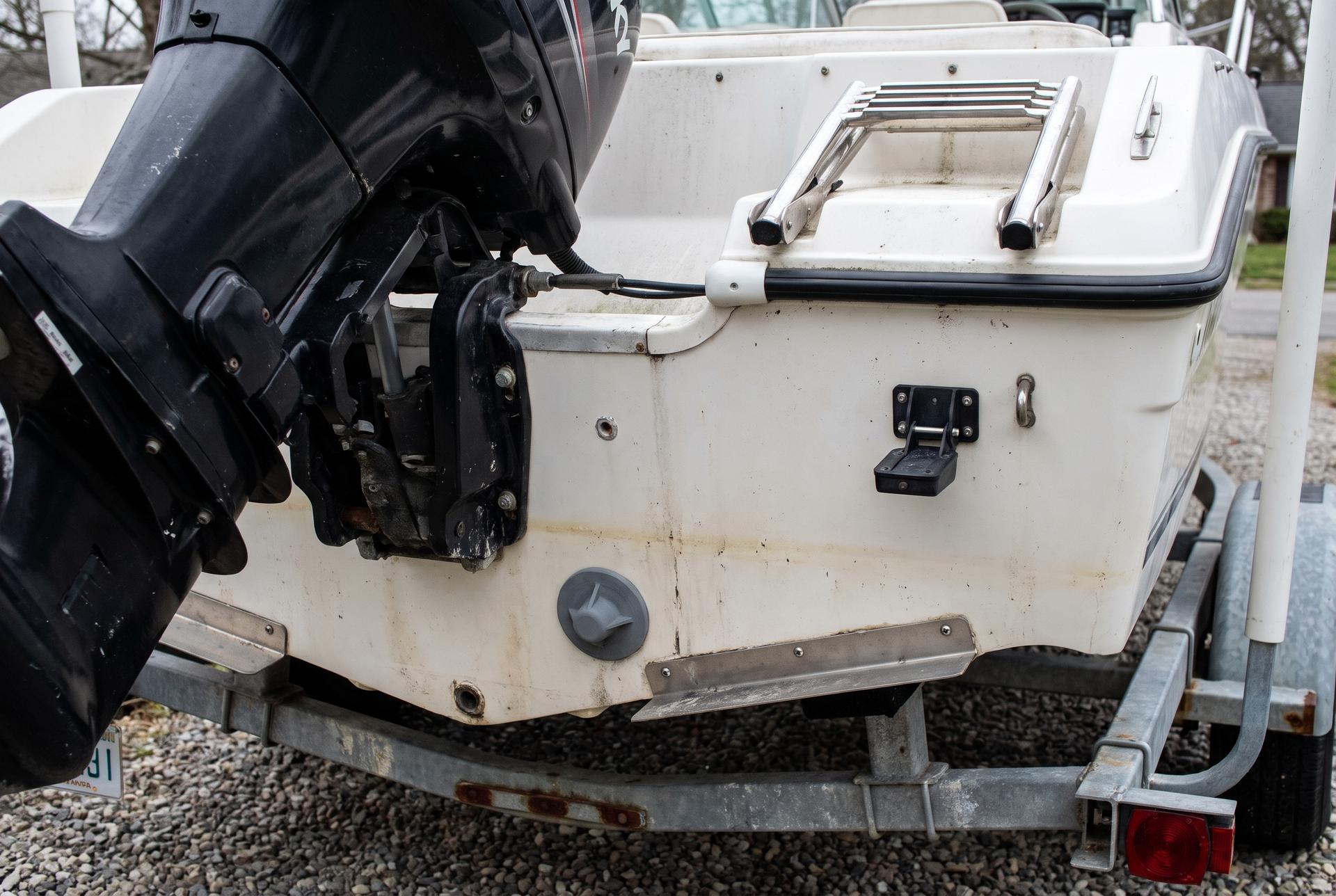
Tilt an outboard up for trailering and the whole weight of the powerhead and lower unit moves aft and up. It is now held by the tilt cylinders or the tilt lock pin, and through them by the motor bracket bolts in the transom. Parked in the driveway that is fine. Towed at highway speed over expansion joints, it is a weight on the end of a lever, moved up and down constantly by road inputs.
A transom saver carries the bottom end of that lever. One end cradles the anti-ventilation plate or clamps around the lower unit, the other end sits in a bracket on the trailer's rear cross member or over the roller shaft. With the bar in place, the motor's weight is shared with the trailer frame and the motor cannot swing.
The second job matters just as much: it takes load off the hydraulic tilt system. Outboard owner manuals commonly set out how a tilted motor should be supported for trailering, whether that is the mechanical tilt support built into the bracket or support on the trailer. The exact wording is in your engine's owner manual, and that is the instruction to follow, not a rule of thumb from a forum.
What a transom saver does not do is fix anything. If the transom is already flexing, a bar between the motor and the trailer can transmit trailer shock up into the same tired laminate. Sort the transom first.
Why trailering loads a transom differently than running
Under way, the transom takes thrust pushing forward and steering load side to side, and the hull is floating on water that spreads the shock out. The motor is trimmed down, so its weight is close to the transom and mostly pulling straight down.
On the trailer the motor is usually tilted fully up. The centre of mass moves aft and higher, which lengthens the lever arm on the mounting bolts, and the suspension passes impacts straight into the hull with nothing to damp them. A pothole that the hull would barely notice afloat becomes a sharp vertical jolt.
This is why trailered boats show transom problems in a particular pattern: stress cracks radiating from the motor bracket bolt holes, a splash well that has started to flex, or bolts you can feel move when you rock the motor by hand. The fix is support on the road plus correctly bedded, washered and backed mounting hardware.
If you want the full picture of what lives back there and what fails, the stern and transom guide covers the structure itself, and the transom repair guide covers finding and fixing rot.
Transom saver, motor support bracket, or trim lock
There are three common ways to deal with a tilted motor on a trailer, and they suit different boats.
The classic transom saver is a telescoping bar with a V cradle at the motor end and a trailer bracket at the other. It is the usual choice for a small to midsize outboard on a bunk or roller trailer where the gap between the lower unit and the trailer is consistent. It transfers load to the trailer, which is the main benefit, and it is the type that most often needs adjusting to length.
A motor support bracket, sometimes called a motor toter or tilt support, is a wedge or strut that fits between the motor bracket and the swivel housing. It holds the motor at a fixed tilt angle without touching the trailer. Nothing is transferred to the trailer, so the transom still carries the motor weight, but the tilt system is relieved and the motor cannot bounce through its tilt range. It is the option to use if your engine's manual says the engine should not be tied to the trailer, and it leaves the suspension free to work.
A trim lock or tilt lock pin is the mechanical stop built into many outboard brackets. It is the minimum, it costs nothing, and your manual sets out how to use it. On a short trip with a light motor that may be all you need.
Which is right depends on your engine maker's instruction, your motor's weight, and the roads you tow on. Check the manual before buying anything. One thing to look for in your own manual is guidance on bars that rigidly connect engine to trailer on heavier engines, because that ties two separately sprung masses together.
Measuring for fit: motor height, tilt angle and trailer setup
Fit is a measurement, not a horsepower rating. Measure the boat loaded on the trailer, hitched to the tow vehicle and sitting level, because an unhitched trailer tipping on its jack changes every dimension.
Tilt the motor to the position you will tow in, usually the first or second tilt detent rather than fully up, so the bar is not at the end of its travel. Then measure from the underside of the anti-ventilation plate down to the top of the trailer cross member or roller shaft where the bar's trailer end will land. That length, plus a little adjustment range either side, is the bar you need.
Check three more things. First, lower unit shape: some cradles fit a standard gearcase but foul a large four stroke's skeg or a stainless skeg guard. Second, trailer attachment: a roller trailer usually takes a bracket that clamps to the roller shaft, while a bunk trailer needs a bracket bolted or clamped to the rear cross member, and some trailers have no convenient flat surface at all. Third, capacity: where the maker publishes a motor weight rating for the bar, check it against your engine's published dry weight plus prop and oil rather than guessing from horsepower.
One practical note that is easy to miss. If the bar is rigid and the boat can still move fore and aft on the bunks, the bar gets loaded sideways every time the boat shifts. Transom tie-downs that stop the hull moving are what make a transom saver work properly.
The rest of the trailering chain: winch strap, tie-downs and bow support
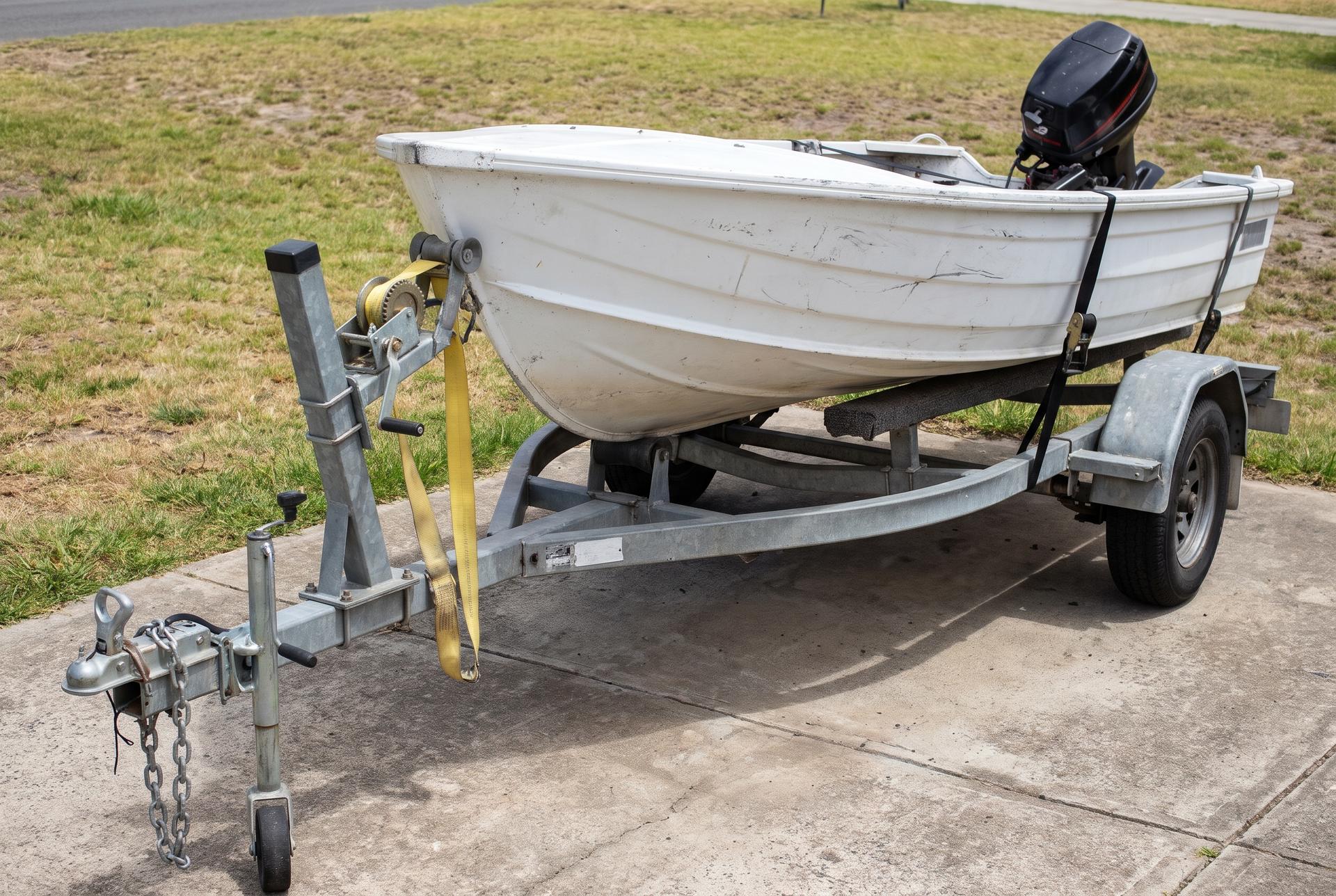
The winch strap pulls the bow up against the bow stop and keeps the boat from sliding back. It is the single most loaded piece of webbing on a trailer and it lives in sunlight and salt water, so it is also the piece most likely to be a few years past its best. Replace it when you see fuzzed edges, cuts, a stiff section, or stitching that has started to pull. UV makes polyester webbing chalky and weak long before it looks broken.
Width and length are what you match. Two inch webbing suits most small and midsize trailers, three inch is used on larger or heavier rigs, and length is set by how far your winch sits from the bow eye plus the run down into the water at the ramp. GearPort stocks Rod Saver replacement straps in 2 inch and 3 inch widths and lengths from 16 to 25 feet, including one version with a separate safety strap. The WS25 is a 7,000 lb rated polyester belt with a 6,600 lb drop-forged snap hook, and the 3 inch WS3Y25 uses webbing rated at 10,000 lb, so you can match the replacement to the duty of the trailer.
A winch strap is not a tie-down. Always fit the bow safety chain from the trailer frame to the bow eye as well, so the boat cannot leave the trailer if the strap or winch fails.
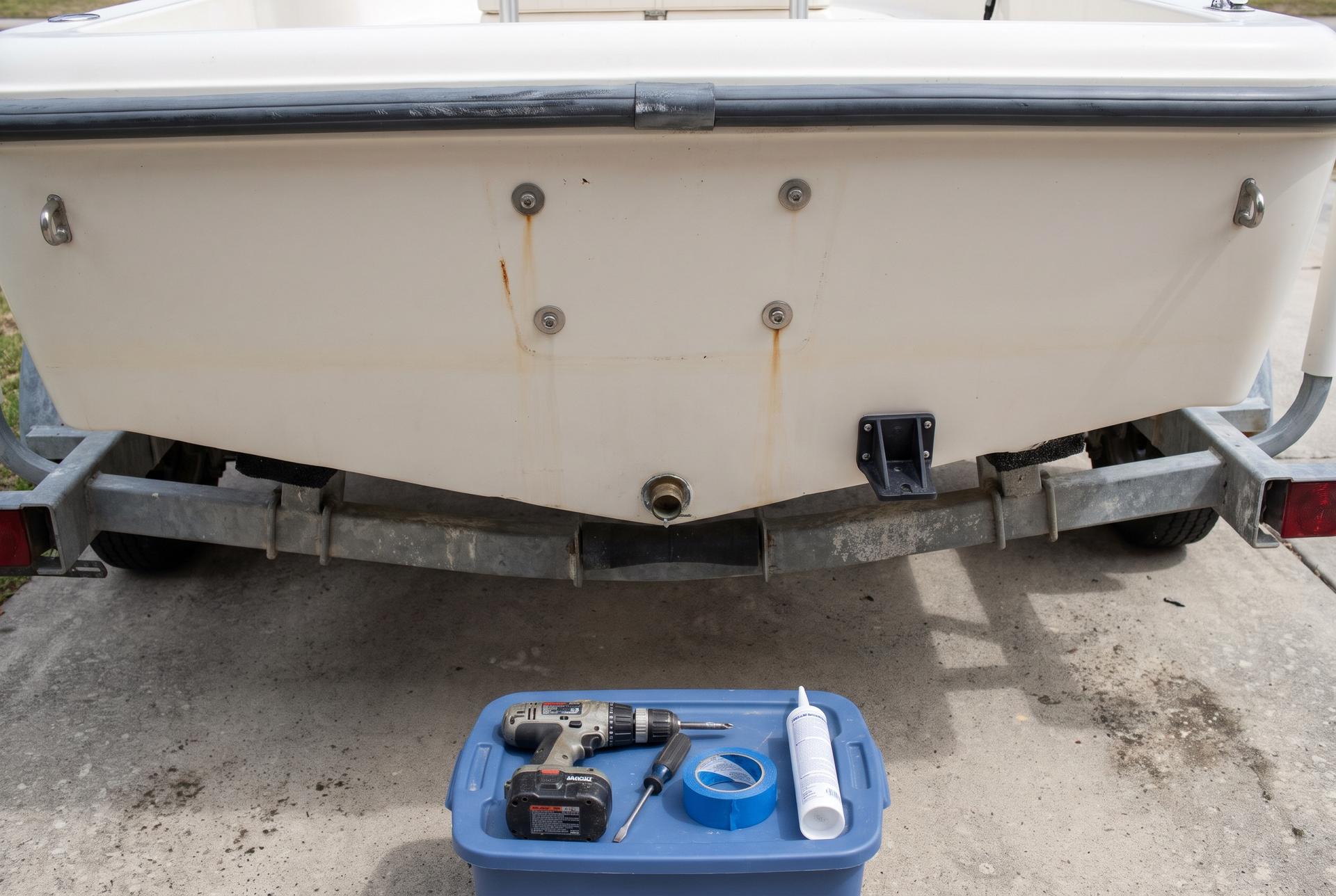
At the back, transom tie-downs pull the hull down onto the bunks. Two straps, one each side, over the transom corners or to the trailer frame. Ratchet straps give you controlled tension, rubber-sprung straps keep tension as the hull flexes, and permanently mounted retractable or stainless straps save you hunting for them at the ramp. The store carries Rod Saver stainless transom tie-downs rated to a 1,200 lb working load, Rod Saver rubber ratchet tie-downs at 1,800 lb rated capacity per pair, and bolt-on Camco retractable straps in 2 inch width.
Gear that rides on the transom and needs checking after a tow
The transom is the busiest panel on a small boat, and most of what is bolted to it is in the splash zone behind the motor where road grit and vibration do their work.
Walk the back of the boat after a long tow and check the motor bracket bolts for movement, the anode on the lower unit and bracket for looseness, the skeg for new chips from low clearance driveways, the transducer bracket for a changed angle, and the motor well boot or rigging grommet for splits that let water into the splash well. A transducer knocked off square reads badly at speed and the usual cause is something hitting it on the trailer, not on the water.
Drive out the drain plug check too. A loose plug and a leaking boot together mean you arrive with water in the bilge, which adds weight exactly where you do not want it on the next tow.
GearPort stocks replacement skegs, outboard anode kits, motor well boots and outboard flush port fittings, so a post-tow repair list usually matches a single order.
How to load, strap and inspect before every trip
Do it in the same order every time and it takes two minutes.
Load the boat until the bow eye touches the bow stop. Crank the winch tight and lock the handle. Fit the bow safety chain. Tilt the motor to your towing position and engage the tilt lock or fit the support, then set the transom saver and lock its adjustment so it cannot creep longer. Fit both transom tie-downs and tension them evenly, so the hull is pulled down onto the bunks rather than pulled to one side.
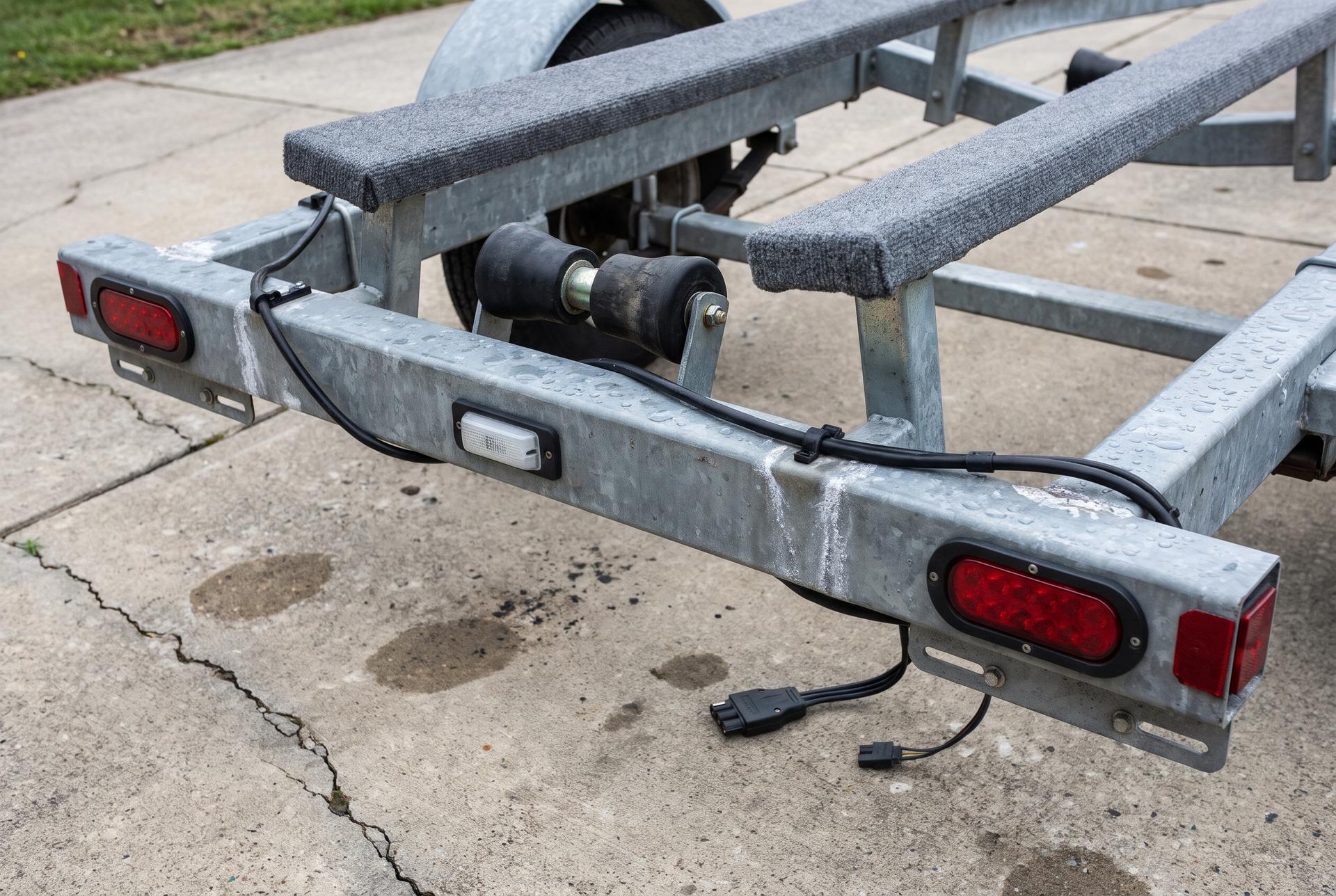
Then walk the trailer: lights working, coupler latched and pinned, safety chains crossed under the coupler, jack fully retracted and the jack wheel clear, tyre pressures and lug nuts, and anything loose in the boat stowed or strapped. Rod holders, seats and coolers all walk around on a trailer.
Stop after the first few miles and feel the hubs, recheck the strap tension, and look at the motor support. Webbing seats in under load and most straps need a second tighten. Repeat the quick check at every fuel stop on a long run.
| Item | What to confirm | Common failure |
|---|---|---|
| Winch strap | Tight, handle locked, webbing clean of cuts and fuzz | UV-aged webbing, worn snap hook |
| Bow safety chain | Attached to bow eye and frame, slack taken up | Left off entirely |
| Motor support | Tilt lock engaged or bar set and locked at length | Adjustment creeping longer |
| Transom tie-downs | Both sides, even tension, hull down on bunks | One side only, or ratchet backed off |
| Trailer | Lights, coupler, chains, jack up, tyres | Jack left part way down |
| Loose gear | Rods, seats, cooler, battery secured | Items shifting into hull sides |
A pre-trip sequence, not a standard. Follow your boat, trailer and engine manuals where they are more specific.
When a transom saver is the wrong answer
Three situations where fitting a bar is not the move.
If your engine manufacturer tells you to support the motor on its own tilt mechanism and not on the trailer, follow the manual. A rigid bar between a heavy engine and a trailer frame means every trailer impact goes straight into the engine mount.
If the transom already flexes, creaks, or shows cracks around the bracket bolts, a support bar can make things worse by adding a second load path into damaged laminate. Fix the structure first.
And if the problem is really that the boat moves on the trailer, the answer is correctly adjusted bunks and proper transom tie-downs, not a bar. A boat that is strapped down tight and sitting evenly on its bunks puts far less stress on everything behind the splash well than one held only at the bow.
Replacement winch straps
Rod Saver replacement winch straps in the widths and lengths that fit most boat trailer winches.
Transom tie-downs and trailering straps
Straps that hold the hull down on the bunks, from stainless transom tie-downs to retractable bolt-on sets.
Trailer and launch hardware
Winches, jacks and a motor dolly for handling the boat and engine off the water.
Common questions
- What does a transom saver do?
- It carries the weight of a tilted outboard down onto the trailer frame instead of leaving it hanging on the transom and the tilt system. One end cradles the lower unit or anti-ventilation plate, the other sits in a bracket on the trailer's rear cross member or roller shaft. It stops the motor swinging and reduces the shock load passed into the motor mounting bolts while towing.
- Do I actually need a transom saver, or is the tilt lock enough?
- Check your engine's owner manual first, because manufacturers differ. The built-in mechanical tilt lock is the baseline and may be all that is specified for your motor. Heavier engines, rough roads and long tows are where extra support earns its place. Some makers prefer a motor support bracket that holds tilt angle without touching the trailer, rather than a bar tied to the frame.
- How do I size a transom saver to my motor?
- Measure, do not go by horsepower. Hitch the trailer so it sits level, tilt the motor to the position you will tow in, then measure from under the anti-ventilation plate to the trailer cross member or roller shaft. Buy a bar whose adjustment range covers that length with room to spare, and check its rated motor weight against your engine's dry weight plus prop and oil.
- When should I replace a trailer winch strap?
- Replace it when you see cuts, fuzzed or frayed edges, chalky faded webbing, a stiff salt-caked section, or stitching that has begun to pull at the hook. Polyester webbing weakens from UV long before it looks broken, so an old strap on a trailer that lives outdoors is worth changing on age alone. Check the hook and its keeper at the same time.
- What width and length winch strap do I need?
- Match the width your winch drum is built for, usually 2 inches on small and midsize trailers and 3 inches on heavier rigs. For length, measure from the winch to the bow eye with the boat loaded, then add the extra you need to reach the bow eye when the trailer is backed down the ramp. Common replacement lengths run from 16 to 25 feet.
- Are transom tie-downs still needed if I have a transom saver?
- Yes. A transom saver supports the motor, it does not hold the boat on the trailer. Transom tie-downs pull the hull down onto the bunks so it cannot lift or shift, which also stops the support bar being loaded sideways. Use two, one each side, tensioned evenly, plus the winch strap and bow safety chain at the front.