 GearPort
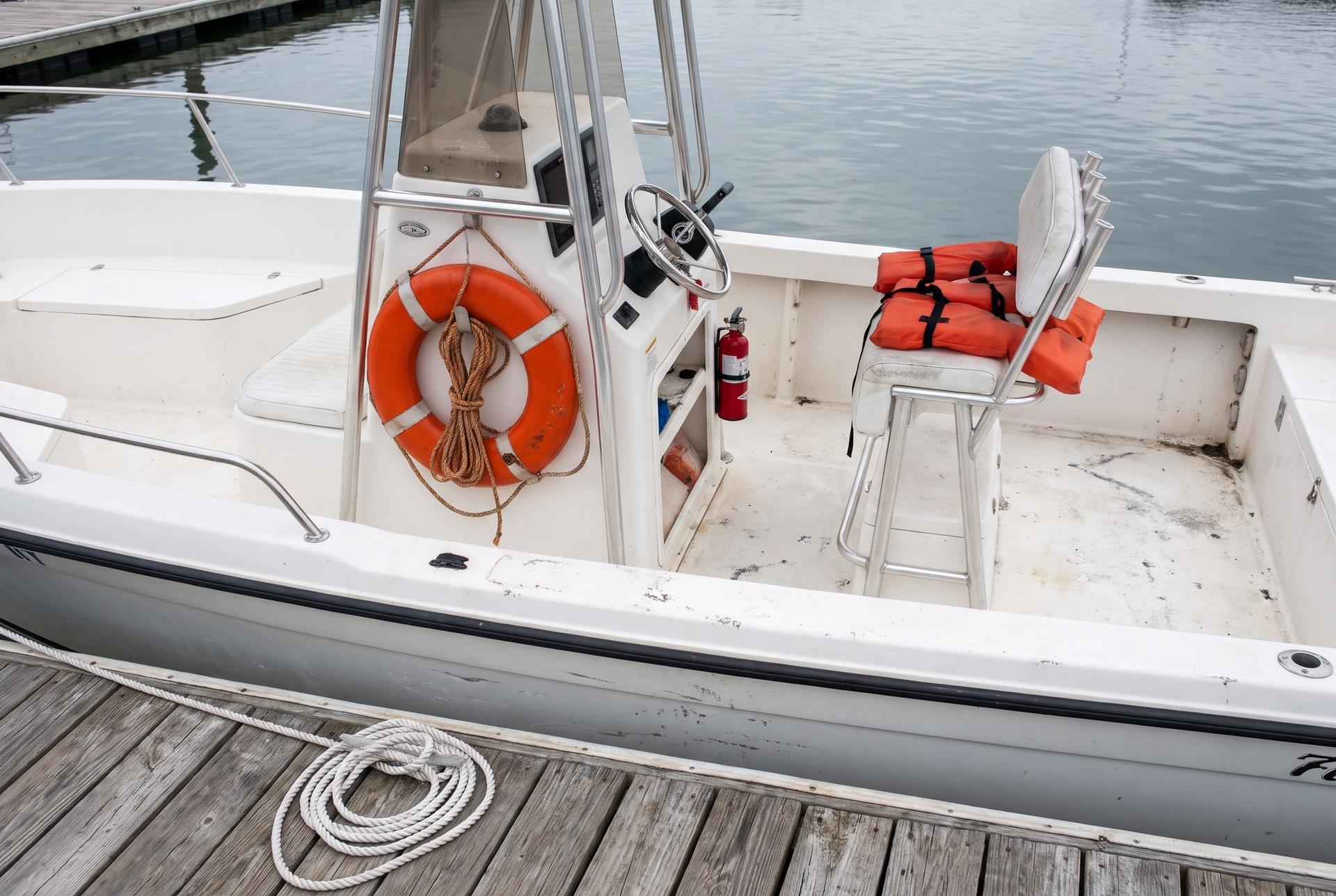
Boat Safety Equipment: What the Coast Guard Requires on Board
A recreational boat on United States waters has to carry life jackets for everyone aboard, a throwable flotation device on boats 16 feet and over, a sound signalling device, fire extinguishers if the boat has enclosed fuel or engine spaces, visual distress signals on coastal and Great Lakes waters, backfire flame control and ventilation on inboard gasoline engines, and navigation lights if it runs between sunset and sunrise or in reduced visibility. The exact counts and classes change with the length of the hull and with where you are boating.
Those rules come from federal regulation, enforced by the United States Coast Guard, and they are the floor rather than the target. A boat that passes a safety check can still be a boat you would not want to be on in a building sea. The second half of this guide covers the gear that is not on the checklist and matters anyway.
Below: what each required item is for, how to tell which version applies to your boat, where it has to be stowed so it is legal and reachable, and what to check before you buy a replacement. State rules add to this list in places, so treat your state boating agency as the final word on anything local.
Who sets the rules, and what counts as required
Federal carriage requirements for recreational vessels are set in the Code of Federal Regulations and enforced by the United States Coast Guard. They apply to boats operated on waters subject to federal jurisdiction, as defined in the regulations themselves. States add their own requirements on top, commonly around life jacket wear for children, engine cut-off switches and fire extinguisher counts, and the state rule applies wherever the state has authority.
Required equipment has to be more than present. The general pattern across the regulations is that gear must be in serviceable condition, of an approved type where approval is specified, and readily accessible or immediately available depending on the item. A life jacket zipped inside a bow locker under three fenders is not readily accessible. An extinguisher behind a locked hatch is not immediately available.
Approval matters for several categories. Coast Guard approved is a specific status, printed on the label of the device along with an approval number. Life jackets, throwable devices, pyrotechnic visual distress signals and fire extinguishers all carry approval marking when they qualify. If the label has worn off a life jacket to the point it cannot be read, replace it.
The simplest way to confirm your own boat is complete is a free vessel safety check. The Coast Guard Auxiliary and the United States Power Squadrons run them, they are not law enforcement, and nothing is reported if you fail. You get a list of what is missing and a chance to fix it in the driveway rather than at a boarding.
Life jackets: counts, sizing and where they live
The core rule is one wearable life jacket for each person aboard, Coast Guard approved, in serviceable condition, and of a size and type suitable for the wearer. Boats 16 feet and over also have to carry one throwable device, which is the ring buoy or buoyant cushion you see strapped to a rail or stuffed under a seat.
Sizing is done by body weight and chest size, printed on the label, not by guessing. A child in an adult jacket will slide out of it in the water, which is the whole reason the sizing ranges exist. If children ride on the boat, carry jackets fitted to them and check the fit each season, because children outgrow a jacket faster than the jacket wears out.
Inflatable life jackets are approved for use by adults, with conditions printed on the label about the activity and the vessel. They are comfortable enough that people actually wear them, which is their real advantage, but they are maintenance items. The cylinder has a weight stamped on it, the bobbin or cartridge in an automatic head has a service date, and the bladder needs checking by the inspection procedure the jacket maker states. An inflatable that has fired once and been rearmed badly is worse than a foam jacket.
Stow wearables where someone can reach them without opening a hatch that something is sitting on. Under a seat cushion, in a clearly marked soft bag in the cabin, or in open bins at the helm all work. The throwable goes where it can be thrown from, which means on deck and not buried. Check jackets for rot, hardened foam, torn webbing and seized buckles at the start of every season and after any long storage.
Visual distress signals: flares, flags and electronic alternatives
Visual distress signals are required on coastal waters, the Great Lakes, territorial seas and waters connected to them up to two miles wide at the mouth. On those waters, boats must carry signals approved for day use and for night use. Some boats are exempt from the daytime requirement, including recreational boats under 16 feet, and the exemption list is broader than small boats, but exempt boats still need night signals if operated between sunset and sunrise. Inland lakes and rivers outside that definition generally have no federal visual distress signal requirement, though carrying something is still sensible.
The traditional answer is pyrotechnic: handheld red flares, aerial meteors, parachute flares and orange smoke. Pyrotechnics carry an expiration date stamped on them, and expired devices do not count toward the required carriage, though many people keep expired flares aboard as extras on top of in-date ones. Store them dry, upright and in a sealed container, because damp flares fail at the worst time.
The non-pyrotechnic options are an orange distress flag for day use and an electric distress light for night use. The flag is a square orange cloth with a black disc and square, meant to be displayed where it is visible from the air. The electric light flashes the SOS pattern automatically. Both have the advantage of not expiring in the way a flare does, though the light still needs fresh batteries and a function test.
A practical kit for a coastal boat combines both: handheld flares for the close-range signal that actually gets a searching vessel's attention, plus a flag and an electric light so you still have a legal and usable signal once the pyrotechnics are gone. Keep them in a dedicated waterproof case, label it, and tell everyone who rides on the boat where it is.
Sound signals: horns, whistles and bells
Every boat needs some means of making an efficient sound signal. The Navigation Rules require sound signals for manoeuvring and for restricted visibility, so this is not just a boarding checklist item, it is how you tell another skipper what you are about to do in fog or in a crossing situation.
What you need scales with length. Smaller recreational boats are generally satisfied by a hand-held whistle, an aerosol air horn or an electric horn. Larger vessels have specific requirements for a whistle audible over a stated range and, above a certain length, a bell as well. If your boat is in that larger bracket, check the length thresholds in the Navigation Rules rather than assuming a dash horn covers it.
Electric horns are the convenient answer because they are at the helm and work with a thumb. They also stop working, usually because the horn body corrodes or the feed wire greens off at a crimp. Test the horn on every trip when you test the lights. Tinned marine wire and a sealed connection at the horn terminal is the fix that lasts, and the horn circuit should be fused like any other.
Carry a backup that needs no power. A pea-less plastic whistle on a lanyard attached to each life jacket costs almost nothing and works after the battery is flat and the boat is swamped. That one is not strictly a carriage requirement on most boats, it is just the thing you will want.
Fire extinguishers: class, count and mounting
Marine fire extinguishers are required on boats with conditions where a fuel or engine fire can start and be contained, which includes inboard engines, closed compartments where portable fuel tanks are stored, permanently installed fuel tanks, double bottoms not sealed or completely filled with flotation, and closed living spaces. An open outboard boat with portable tanks in open racks can be exempt, but very few boats are genuinely free of all those conditions.
The extinguishers have to be marine type, Coast Guard approved, and rated for Class B fires, which is flammable liquids. The required number scales with vessel length, and a fixed extinguishing system installed in the engine space can reduce the number of portables required. From 20 April 2022, disposable portable extinguishers more than 12 years past their date of manufacture do not count toward the minimum required on recreational vessels, so an old extinguisher that still shows pressure may no longer count.
Check condition the way the inspector will. The gauge needle in the green band, the pin in place with an unbroken seal, the nozzle clear, the body free of corrosion and dents, and the label readable. Dry chemical can settle if it sits for years, and some owners invert and tap the body to keep the powder loose. Follow the inspection routine the maker prints on the extinguisher.
Mounting is part of the requirement. Extinguishers must be readily accessible, which means in the proper bracket, mounted where someone can grab one without reaching across the fire. The usual places are near the helm, near the companionway or cabin entrance, and near but not inside the engine space. A loose extinguisher rolling in a locker fails on both accessibility and condition, because the handle gets knocked and the unit discharges unnoticed.
Lights, ventilation and backfire flame control
Navigation lights are required from sunset to sunrise and in restricted visibility. The colours, arcs and visibility ranges are set by the Navigation Rules and vary with vessel length and what the boat is doing, which is enough detail that it has its own guide. The short version for buying: fittings need to show the correct arc and the correct range for your boat's length, and the range is a property of the certified fitting, not something you can improve with a brighter bulb.
Three things kill navigation lights, and none of them are the LED. Corroded bulb sockets and pin connectors, chafed wire where it passes through a bulkhead, and a ground return taken to a painted surface instead of a clean bus. Rewiring with tinned marine wire in the right gauge, sealed with adhesive-lined heat shrink, fixes most light faults permanently. Duplex safety cable with red and yellow conductors is common marine practice and keeps the positive and negative identifiable years later.
Boats with gasoline engines have two more requirements that are built in rather than carried. Backfire flame control is the arrestor on the carburettor or throttle body of an inboard gasoline engine, and it has to be in place, clean and secured. Ventilation covers the ducted system that clears fuel vapour from engine and fuel tank compartments, with powered blowers required on boats built on or after 1 August 1980 with enclosed gasoline engine compartments. Run the blower before starting, and then use your nose, because a working blower does not make a fuel leak safe.
If your boat has a marine sanitation device aboard, there are also rules on discharge and on no discharge zones. Overboard discharge valves generally have to be secured in a way that prevents accidental discharge in waters where it is prohibited. Check local rules, because this one is enforced heavily in some areas and barely mentioned in others.
How the list changes with boat length
Carriage requirements are written in length brackets, broadly under 16 feet, 16 to under 26 feet, 26 to under 40 feet, and 40 to 65 feet. Those brackets cover recreational vessels up to 65 feet, and larger vessels fall under different requirements. As you move up the brackets, more items apply and the counts increase: the throwable device comes in at 16 feet, day visual distress signals apply to boats 16 feet and over on the relevant waters, fire extinguisher counts rise with length, and sound signalling equipment becomes more specific.
Measure the length the way the rule does, which is the hull length, not including bow pulpits, swim platforms, outboard brackets or rails. A boat you call a 25 can measure as a 26 on the registration, and that moves it into the next bracket.
Use the table as a shape of the rules, then confirm the exact counts for your boat and your water against the current federal requirements and your state agency. The numbers in the fire extinguisher and distress signal categories have conditions attached, and those conditions are what a boarding officer actually applies.
| Item | Under 16 ft | 16 ft to under 26 ft | 26 ft and over |
|---|---|---|---|
| Wearable life jackets | One per person aboard | One per person aboard | One per person aboard |
| Throwable device | Not required | One required | One required |
| Day visual distress signals (coastal and Great Lakes) | Exempt in many cases | Required | Required |
| Night visual distress signals (coastal and Great Lakes) | Required if operated at night | Required | Required |
| Sound signalling | Required | Required | Required, with more specific equipment on larger vessels |
| Fire extinguishers | Required if one of the listed conditions is present | Required if one of the listed conditions is present, count rises with length | Required, count rises with length |
| Navigation lights | Required sunset to sunrise and in restricted visibility | Required sunset to sunrise and in restricted visibility | Required sunset to sunrise and in restricted visibility |
| Ventilation and backfire flame control | Applies to gasoline inboards and enclosed fuel spaces | Applies to gasoline inboards and enclosed fuel spaces | Applies to gasoline inboards and enclosed fuel spaces |
A shape-of-the-rules summary of federal recreational vessel carriage requirements. Length brackets, extinguisher counts and distress signal conditions come from the federal regulations and the Coast Guard boating safety guidance; confirm the exact counts for your hull length and water before relying on them. State requirements may add to this list.
Beyond the minimum: the gear that actually keeps a boat safe
Nothing on the required list keeps water out of the boat. A bilge pump with an automatic float switch, wired on its own circuit so it works with the battery switch off, is the single most useful piece of safety equipment most boats carry and it is not required on recreational vessels. Pair it with a manual bailer or hand pump for the day the battery is under water, and know where your through-hulls are.
An anchor with enough rode is the other quiet one. An engine that will not start near a lee shore becomes a grounding unless the boat can be stopped. Add a basic tool kit, spare fuses, a spare impeller, hose clamps, self-amalgamating tape and a wooden bung tied near each through-hull. Tools that live in the boat and never go back to the garage are the ones that are there when you need them.
Communication is worth more than any signal device. A fixed VHF with a masthead antenna has range a phone does not, and a handheld VHF in the ditch bag covers the case where the boat has no power. Boats that go offshore should carry an EPIRB or a personal locator beacon, registered, with a battery in date. An engine cut-off switch lanyard or wireless fob, worn, is sensible on any boat that gets up on plane.
Then there is the boring maintenance that prevents emergencies. Fuel line condition and clamps at every joint, battery terminals tight and protected, a charger that maintains the bank over the winter, a float switch tested by hand, and deck surfaces that are not slick when wet. Most of what sinks or burns a recreational boat is something that was visible six months earlier.
Navigation lights and marine wire
Lighting and tinned cable for the circuits that have to work after dark.
Keeping the boat in condition
Bilge cleaner, sealant, wash and polish for the maintenance that prevents problems.
Deck, boarding and hull protection
Boarding handles, keel guards and dock bumpers for the parts of the boat that take hits.
Common questions
- What safety equipment is required on a boat?
- At minimum: a wearable life jacket for every person aboard, a throwable flotation device on boats 16 feet and over, a sound signalling device, visual distress signals on coastal and Great Lakes waters, fire extinguishers where the boat has enclosed engine or fuel spaces, navigation lights for night and reduced visibility, and ventilation plus backfire flame control on gasoline inboards. State rules can add more.
- Do I need flares on an inland lake?
- Usually not under federal rules. Visual distress signal requirements apply to coastal waters, the Great Lakes, territorial seas and connected waters up to two miles wide at the mouth. A small inland lake generally falls outside that. Carrying a signal anyway is still worth it, because an orange flag and an electric SOS light cost little and do not expire the way pyrotechnics do.
- How many fire extinguishers does my boat need?
- It depends on hull length and on whether a fixed extinguishing system is installed in the engine space. Boats with enclosed engine compartments, permanently installed fuel tanks, enclosed living spaces or closed compartments holding portable tanks need marine type extinguishers rated for Class B fires, with the count rising with length. Check the current federal requirement for your length bracket.
- Do life jackets expire?
- Foam life jackets have no expiration date, but they have to stay in serviceable condition: no rips, no rot, no hardened or compressed foam, working buckles and a readable approval label. Inflatable jackets are different. The cylinder, the automatic inflator cartridge and the bladder all need checking, and most makers specify a service interval printed on the jacket.
- Where should fire extinguishers be mounted on a boat?
- In their brackets, readily accessible, and positioned so you are never reaching across a fire to get one. Common spots are near the helm, near the cabin or companionway entrance, and close to but not inside the engine compartment. Loose extinguishers in a locker do not count, because they get knocked, discharge unnoticed and are not accessible in a hurry.
- What is a vessel safety check and does it cost anything?
- It is a free, voluntary inspection by the Coast Guard Auxiliary or the United States Power Squadrons. A trained examiner walks your boat against the federal and state requirement list and tells you what is missing. It is not law enforcement and failing is not reported anywhere. Boats that pass are given a decal to display.
Sources
- United States Coast Guard recreational boating personal flotation device carriage requirements, 33 CFR Part 175 Subpart B
- 33 CFR Part 175 Subpart B, personal flotation devices
- 33 CFR Part 175 Subpart C, visual distress signals
- 33 CFR 175.110 exemptions, visual distress signals
- 33 CFR Part 175 Subpart C and USCG Boating Safety guidance on visual distress signals
- 33 CFR Part 175 Subpart C, approved visual distress signal types
- Navigation Rules, International-Inland, Rule 33 and Annex III equipment for sound signal appliances
- Navigation Rules, International-Inland, Rules 34 and 35
- 46 CFR Subchapter S fire protection equipment requirements for recreational vessels, as summarised in USCG Boating Safety guidance
- USCG Boating Safety equipment requirements, fire extinguishers
- USCG fire extinguisher carriage requirement change effective April 20, 2022
- Navigation Rules, International-Inland, Rule 20
- 33 CFR Part 183 Subpart K ventilation and 33 CFR 183.610 backfire flame control
- USCG Boating Safety federal requirements for recreational vessels, length classes
- USCG Auxiliary Vessel Safety Check program
- 33 CFR Part 159 marine sanitation devices and EPA no discharge zone designations
- 33 CFR Part 183 Subpart K, ventilation