 GearPort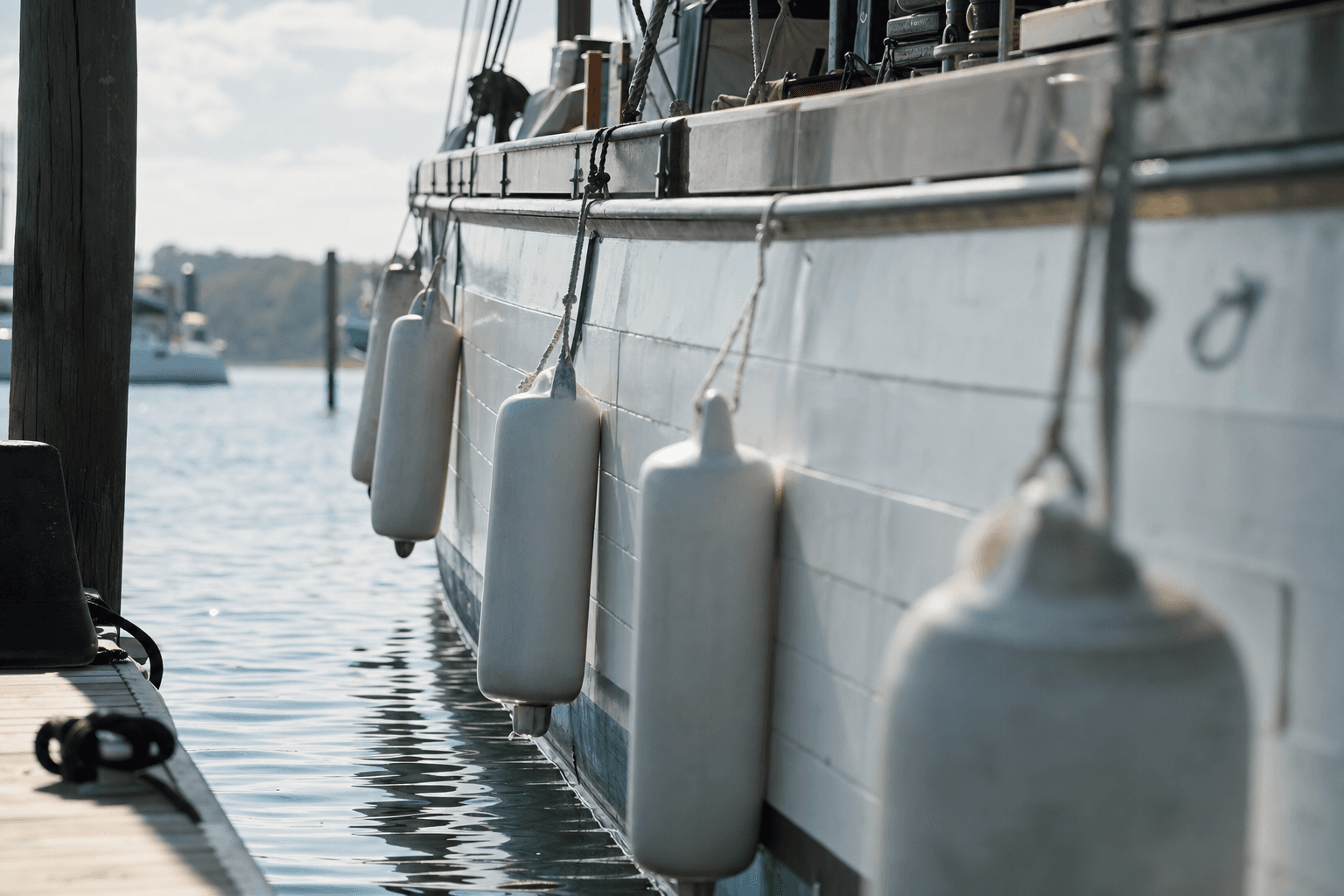
Fender sizing: what size, how many, and where they go
Fenders are cheap next to the damage they prevent, and they are easy to under-buy. Too small and they compress to nothing at the moment they are needed; too few and there is always one gap exactly where the piling is.
The sizing question has a straightforward answer, and then a set of reasons to go bigger.
What size
The working rule of thumb for cylindrical fenders is one inch of fender diameter for every four to five feet of boat length. Do the arithmetic rather than guessing: 24 feet divided by five and by four gives 4.8 to 6 inches, so a 24 foot boat lands on a 5 or 6 inch fender, and a 32 footer works out at 6.4 to 8 inches. It is a rule of thumb rather than a standard, and fender makers publish their own size charts, so check the chart for the fender you are actually buying.
Round or ball fenders are sized differently because their shape does the work: the commonly published guidance, again a rule of thumb, is two inches of diameter per four to five feet of length, which is simply double the cylindrical figure. They suit bows, high freeboard and rafting up, where a cylinder would roll out of position.
Then size up, rather than down, if any of the following apply: a heavy displacement boat, a rough or exposed slip, high docks or pilings where a fender has to bridge a bigger gap, significant tidal range, or rafting alongside another boat. The rule of thumb assumes an ordinary slip on a calm day, which is not when fenders matter.
| Boat length | Cylindrical diameter | Round diameter |
|---|---|---|
| 15 to 20 ft | 3 to 5 in | 6 to 10 in |
| 20 to 25 ft | 4 to 6 in | 8 to 12 in |
| 25 to 30 ft | 5 to 8 in | 10 to 16 in |
| 30 to 35 ft | 6 to 9 in | 12 to 18 in |
| 35 to 45 ft | 7 to 11 in | 14 to 22 in |
| 45 to 50 ft | 9 to 13 in | 18 to 26 in |
| 50 to 60 ft | 10 to 15 in | 20 to 30 in |
Worked out on this page from the rule of thumb above, not copied from a manufacturer chart. Each row applies the rule to the ends of its length band: the shorter boat divided by five, the longer divided by four, rounded to the nearest inch. The round column is double the cylindrical one, which is what the two inch version of the rule comes to. Treat the figures as a calm-day minimum, size up for weight, exposure, high docks, tide or rafting, and follow the maker's own chart where it differs.
How many
A common working number is one fender for every 10 feet of waterline length, and few boats are well served by fewer than three: two working the dock side and one spare for the corner, the unexpected raft-up, or the fender that goes over the side. Nobody sets a legal minimum, so treat both figures as a starting point rather than a requirement.
In practice most owners end up with more than that, because docking is not symmetrical. The bow and the widest point of the hull take the load, and a stern quarter fender earns its place the first time you come in with wind on the beam.
A note on the spare: fenders are consumable. They abrade, they lose air, and they occasionally sacrifice themselves. Having one more than you need is the difference between a scuff and a gelcoat repair.
Cylindrical, round, and flat
Cylindrical fenders with an eye at each end are the default, and they are what most boats hang. They work vertically against a flat hull side or horizontally against a piling, and they stow easily.
Round or ball fenders hold more volume for their contact area, which is why they turn up at the bow, against a high wall, or between two boats rafted together. Flat fenders and fender pads trade the other way: almost no locker space, less cushioning for the same footprint. Both are specialist answers next to a cylinder, so look for one only where the berth gives you a reason.
Hanging them so they work
Height is what makes it work. A fender is only doing its job while it is between the hull and the hard thing. A good starting point is the widest part of the fender at the point of contact, often just below the rub rail, then adjust it for the height of the dock or piling you are actually lying against.
Tie to something structural. A cleat, a rail with a purpose-made fender holder, or a dedicated fender line. Tying to a lifeline or a flimsy rail transfers the load to the wrong place.
Account for the tide. A fender set perfectly at high water can be sitting on top of a piling by low water. In any tidal berth, either set them for the range or check them.
Use fender covers if the fender rubs against the hull. A bare fender picks up grit and can polish a dull patch into the gelcoat; a cover in a soft acrylic or polyester fabric prevents that and keeps black streaks off the topsides.
Take them in under way. Fenders left hanging while running get scuffed, and they are easy to lose over the side.
Cleats, chocks and dock hardware
What the fender and the dock line actually tie to: folding and fixed cleats in 316 stainless, chocks, and dock edging.
Common questions
- What size fenders do I need for my boat?
- As a rule of thumb, allow one inch of cylindrical fender diameter for every four to five feet of boat length. A 24 foot boat works out at 4.8 to 6 inches, so a 5 or 6 inch fender. Round or ball fenders take about double that, roughly two inches of diameter per four to five feet. Size up for a heavy boat, an exposed slip, high docks, a big tidal range or rafting up, and check the size chart for the fender you are buying.
- How many fenders does a boat need?
- A common working number is one per 10 feet of waterline length, with three as a sensible floor for most boats rather than a rule anyone sets. Most owners carry more, because the bow and the widest point of the hull both take load and a spare is worth having.
- What is the difference between cylindrical and round fenders?
- Cylindrical fenders hang from an eye at each end and give a flat contact patch against a hull side or a piling. Round or ball fenders provide more volume for their contact area, which suits bows, high walls and rafting alongside another boat.
- How high should a fender hang?
- Start with the widest part of the fender at the point of contact, often just below the rub rail, then adjust for the dock or piling in front of you. In a tidal berth, set them for the range or plan to adjust them, because a fender set at high water can end up above the piling later.
- Do I need fender covers?
- If the fender touches the hull, they are worth having. A bare fender traps grit, which can polish a dull patch into gelcoat over time, and covers also keep black streaks off the topsides.