Nylon dock lines: sizing, lengths and how to tie up at a dock
Buy nylon, in three strand or double braid, sized to your boat rather than to the cleat. A common rule of thumb for dock line length is a bow and stern line about two thirds of the boat's length, and spring lines about the full length of the boat. Four lines tie a boat up. Six, with two springs, keep it where you put it.
Nylon is the rope of choice for docking because it stretches. That stretch is the whole point. A dock line is a shock absorber as much as a tether, and a line with no give passes every wake and gust straight into the cleat, the deck core underneath it, and the bolts holding the dock together.
This guide covers which construction to buy, how to pick diameter and length, how many lines a slip or a face dock needs, where spring lines go and what each one prevents, when bungee or shock absorbing lines are worth the money, and how to tie off so the boat is still sitting level when the tide drops four feet at three in the morning.
Why dock lines are nylon, and what three strand and double braid each do
Nylon is used for dock lines because it is strong, it resists rot and sunlight reasonably well, and it stretches under load and recovers. Polypropylene floats and is cheap but it is weaker for its size, it hardens in sunlight, and it has almost no useful stretch. Polyester has excellent strength and very little stretch, which is what you want in a halyard and not what you want on a cleat. For docking, the elasticity of nylon is a feature, not a compromise.
Three strand nylon is three bundles of fibre twisted together. It is the traditional dock line: cheaper, grippy in the hand, easy to splice yourself with a fid and a few minutes of practice, and it has the most stretch of the common constructions. It also tends to kink, it can hockle if it gets twisted, and it feels coarser.
Double braid nylon is a braided core inside a braided cover. It is softer in the hand, it coils flat without twisting, it looks tidier on a dock, and it generally costs more. It stretches less than three strand of the same diameter, which makes it the better pick on a boat that already has lots of snubbing built in, or where you want firm positioning in a tight slip.
Either one works. Pick three strand if you want maximum give and the lowest cost per foot and you are happy splicing your own eyes. Pick double braid if you want easier handling and a line that stays neat in a locker.
Picking diameter and length for your boat
Diameter is chosen from boat length and displacement, not from how thick the line feels. The widely used convention is roughly 1/8 inch of line diameter for every 9 feet of boat, rounded up, with heavier boats going a size up. The result is a line that is strong enough and, just as importantly, that fits through the chock and around the cleat horn without jamming.
A line that is too thick is a real problem. It will not take a proper turn on a small cleat, it is hard to adjust under load, and it sits badly in a chock. A line that is too thin stretches too far, chafes through faster, and concentrates load on a narrow strip of the cleat.
For length, the usual starting point is bow and stern lines at about two thirds of the boat's overall length, and spring lines at about the boat's full length. In a slip with pilings well forward or aft, or on a face dock where the shore cleats are spaced wide, you will want longer. Buying spring lines a little long costs almost nothing and gives you room to re-rig when the only free cleat is in the wrong place.
Buy a matched set and then add a couple of long spares. The spares become storm lines, a breast line, a tow line in a pinch, and the thing you hand to the person on the dock who has nothing to catch.
How many lines you need: bow, stern and spring lines
Four lines tie a boat to a dock: a bow line, a stern line, and two spring lines. On a finger pier or in a slip you may run six, adding a second bow line and a second stern line to opposite pilings so the boat is centred rather than held against one side.
The bow line runs forward from a bow cleat to a dock cleat ahead of the boat. The stern line runs aft from a stern cleat to a dock cleat behind it. Both should lead well along the dock rather than straight out to the side. A short, square line holds the boat tight against the dock and leaves nothing to absorb a rise in water level.
A breast line runs straight out from the boat to the dock at ninety degrees. It is useful for holding the boat alongside while loading, and it is a poor overnight line because it goes bar tight the moment the water drops. Treat it as a temporary line.
Keep a set of lines made up for the home slip, with the eyes already adjusted to the right pilings, and a separate set of general purpose lines in a locker for visiting docks and fuel stops. It saves a lot of fiddling in a crosswind.
| Line | Runs from | To | What it controls |
|---|---|---|---|
| Bow line | Bow cleat | Dock cleat forward of the bow | Holds the bow in, limits drift aft |
| Stern line | Stern cleat | Dock cleat aft of the stern | Holds the stern in, limits drift forward |
| After bow spring | Bow or forward cleat | Dock cleat aft of that cleat | Stops the boat moving forward |
| Forward quarter spring | Stern or aft cleat | Dock cleat forward of that cleat | Stops the boat moving aft |
| Breast line | Midship cleat | Dock cleat abeam | Holds the boat alongside, temporary use only |
Names follow the common convention of naming a spring line for the end of the boat it starts at and the direction it leads.
Where spring lines attach and what they stop the boat doing
Bow and stern lines stop a boat drifting away from the dock. They do very little to stop it sliding forward and back along the dock, and that surging is what chews up fenders, bangs the swim platform into a piling, and wakes you up. Spring lines are the ones that stop fore and aft movement.
A spring line runs diagonally. The after bow spring starts at a cleat near the bow and leads aft to a dock cleat behind it, so when the boat tries to move forward, that line comes tight and stops it. The forward quarter spring starts near the stern and leads forward, stopping the boat moving aft. Run both and the boat is locked fore and aft while still free to rise and fall.
The flatter the angle, the better a spring works and the less the boat moves when the water level changes. This is why spring lines are long. A spring that runs almost parallel to the dock can take a big change in height with very little change in tension. A short, steep spring cannot.
Springs are also the most useful line when you are coming in alone. Get one spring on a dock cleat and onto a boat cleat, then use the engine against it, and the boat will pull itself alongside and hold there while you walk the other lines ashore. Learn that one trick and single handed docking gets much calmer.
Bungee and shock absorbing dock lines: when the stretch helps
Bungee dock lines, sometimes sold as shock absorbing or elastic dock lines, build the give into the line itself. Some are a rope with a bungee core, others are a conventional nylon line with a coiled elastic section or a rubber snubber spliced into it. They all do the same job: take the sharp peak out of a snatch load before it reaches the cleat.
They earn their place in a few situations. A slip that gets constant wake from a channel, a boat left for weeks on a fixed dock with big tides, a small boat whose cleats are bolted into a thin deck, or a trailer boat on a mooring float. They are also easy for guests to handle, because the line self tensions instead of needing adjustment.
The caution is that elastic is not strength. A shock absorbing line should still be sized like a regular dock line for the boat, and the elastic element is a wear item: the rubber perishes, the coil loses its spring, and the stitching on an integrated snubber is a place to inspect. In heavy weather, many people take the bungee lines off and run plain oversize nylon with long, flat leads, because what you want in a blow is a long line, not a springy one.
A cheaper middle route is a snubber, a short rubber or spring device that clips onto a normal nylon line. You keep the conventional line and add the give only where you want it.
Tying up: the cleat hitch, the eye over a cleat, and leaving slack
The cleat hitch is the knot for a dock line, and most people tie it wrong by adding too many turns. Bring the line to the far side of the cleat and take one full turn around the base. Then cross over the top in a figure eight, over the opposite horn, and back. One or two figure eights is enough. Finish with a single locking hitch, which is a figure eight turn with the line twisted so the tail is trapped under itself, and leave the tail pointing away from the strain. Done right, it holds under load and still comes free once the load is eased.
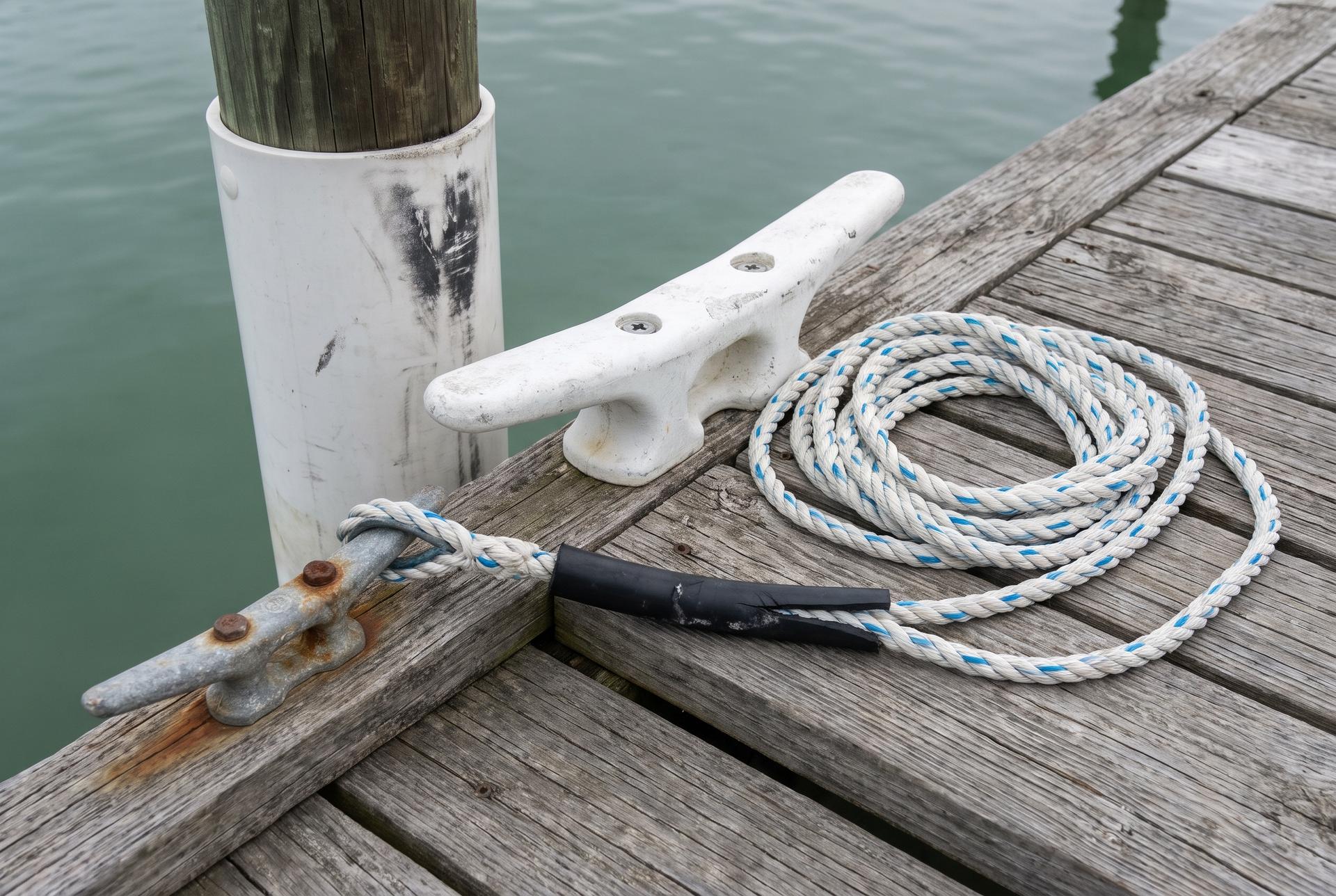
At the other end, most dock lines have a spliced eye. On a dock cleat, the correct way to drop an eye over a cleat that already has a line on it is to pass the eye up through the existing eye from underneath, then over the horns. Either line can then be removed without disturbing the other. For a piling, the eye simply drops over the top, but check how far it can ride up and down as the water moves.
Which end gets the eye matters. Keep the spliced eye on the boat cleat and make the adjustable, cleat-hitched end off on the dock, so you can tune tension from the dock without reaching down over the side. On a short stay where someone on the dock is taking your lines, do the opposite and hand them the eye.
Slack is the part that gets missed. On a floating dock, the dock rises with the boat and lines can be fairly snug. On a fixed dock in tidal water, every line needs enough slack to cover the full range of the tide plus any surge, and long flat leads do most of that work for you. Set lines at low water and picture the boat four or more feet higher, then set them again at high water and picture the drop. If you cannot do both, rig long and accept a little movement.
Chafe, bumpers and fenders: protecting the line and the hull
Nylon dies from abrasion long before it dies from load. Every place the line crosses an edge is a wear point: the chock, the rubrail, the lip of the dock, the top of a piling. Check those spots first on any line that is a year old, because the outside can look fine while the fibres inside the bend have gone fuzzy and dull.
Fit chafe gear wherever a line crosses an edge. A length of split hose, a purpose made chafe sleeve, or a wrap of heavy canvas lashed in place all work, as long as it is secured so it cannot creep out of position as the boat moves. Round off or pad the hardware too: a rough chock lip or a sharp corner on a dock cleat will cut a line far faster than the load will.
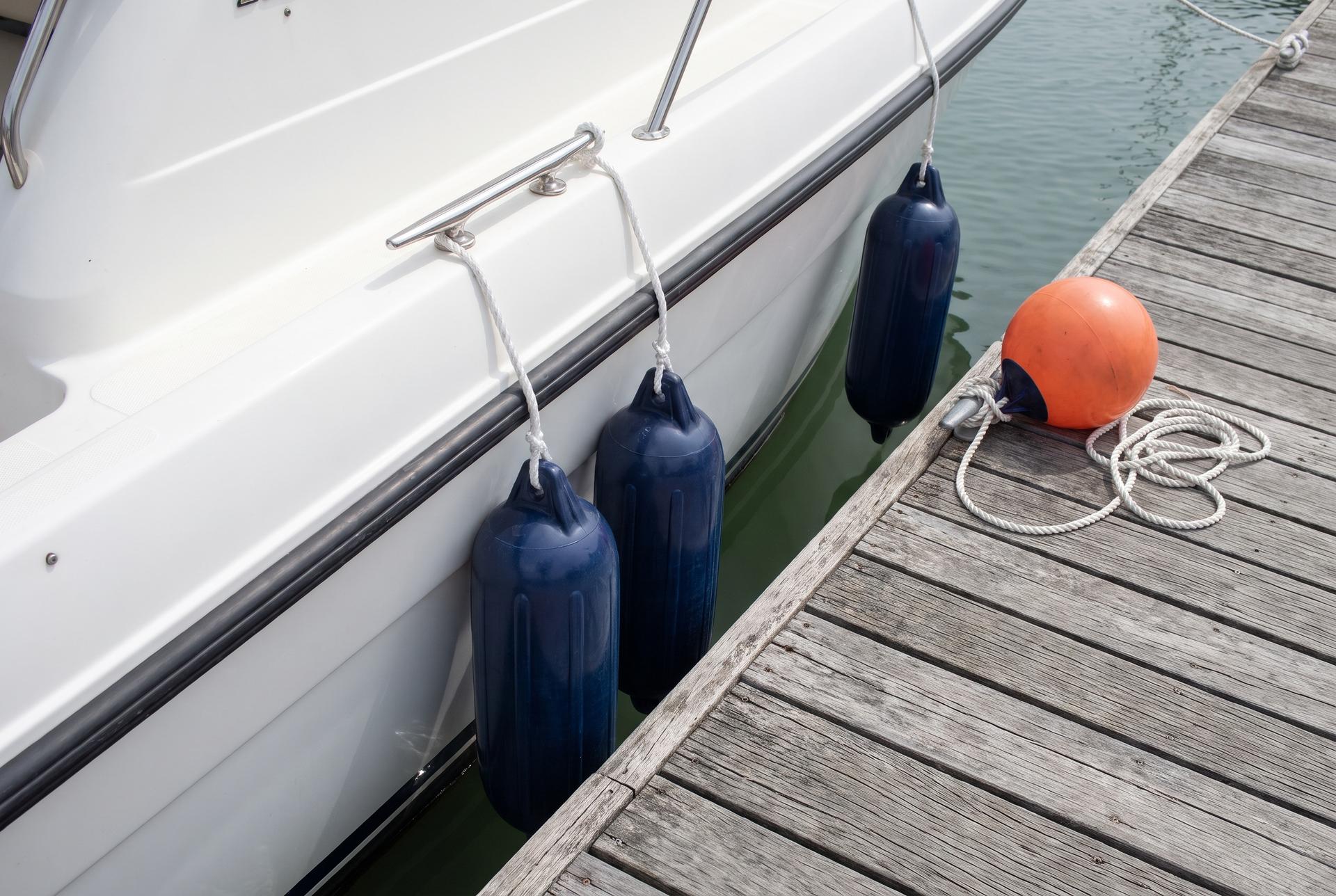
Protect the dock side as well. Dock bumpers take the hit before the hull does, which matters most on pilings, dock corners and the edge of a finger pier where a fender tends to roll out of the way. Piling bumpers wrap the post, D and C profile rolls run along a dock edge, and corner kits cover the one place everybody catches. The store stocks Dock Edge piling bumpers, dockside bumpers, PVC profile rolls and a three piece dock guard kit.
Dock bumpers do not replace fenders on the boat. Bumpers cover fixed hazards on the dock, fenders cover the hull at whatever height the boat happens to be sitting. Run both. For how many fenders to carry and what size suits your boat, see the fender sizing guide.
Storage, inspection and when to retire a line
Nylon loses strength as it ages from sunlight and salt, and it loses it quietly. Rinse lines with fresh water when you can, especially before putting them away for a season, because dried salt crystals grind the fibres from the inside each time the line flexes. Lines can be washed in fresh water and dried out of direct sun before storage.
Store them dry, coiled loosely, somewhere ventilated. A wet line stuffed into a sealed locker will mildew, and while mildew itself is mostly cosmetic on nylon, a locker that stays wet is also the locker where lines get crushed and contaminated with fuel and oil.
Inspect by feel as much as by eye. A good nylon line is supple and springy. Retire it when it has gone stiff and chalky, when the outside is heavily fuzzed or glazed from abrasion, when a double braid cover has moved relative to its core or shows a lump or a hollow spot, when three strand has opened up and the inner fibres look powdered, or when there is a cut, a melted patch or a hard section. Fading alone is not proof of failure, but fading with stiffness is.
Retired dock lines are not rubbish. Cut them into fender pennants, spring line extensions, bucket lanyards and chafe pad lashings, and keep one long piece in the locker as a spare.
Dock bumpers and piling protection
Fixed protection for pilings, dock edges and the corner everyone catches.
Dock hardware
Cleats and dock fittings that the lines actually land on.
Common questions
- What size dock lines do I need for my boat?
- Size diameter from boat length and weight, using the common convention of about 1/8 inch of diameter for every 9 feet of boat, rounded up, and one size larger for a heavy boat. Then check it physically: the line has to take a full turn plus two figure eights on your cleat and pass through the chock without jamming.
- How long should dock lines be?
- The usual starting point is bow and stern lines around two thirds of the boat's overall length, and spring lines around the full length of the boat. Go longer if your slip has pilings set well forward or aft, or if you tie to a fixed dock with a big tide range, because a long, flat lead absorbs height change with little change in tension.
- Are bungee dock lines worth it?
- They help in a wake-prone slip, on a fixed dock with large tides, or on a boat with lightly built cleats, because they take the peak off snatch loads. Size them like any dock line, since elasticity is not strength, and treat the rubber or coil as a wear item to inspect. Many owners swap to plain oversize nylon with long leads before heavy weather.
- What do spring lines actually do?
- They stop the boat sliding forward and back along the dock. An after bow spring runs aft from a forward cleat and stops the boat moving ahead. A forward quarter spring runs forward from an aft cleat and stops it moving astern. Run both and the boat is held fore and aft while still free to rise and fall with the tide.
- Which end of the dock line should have the spliced eye?
- For a home slip, put the spliced eye on the boat cleat and make the adjustable end off on the dock, so you can tune tension from the dock without leaning over the side. When a dockhand is taking your lines at a transient berth, hand them the eye instead and cleat the working end on board.
- How do I share a dock cleat that already has a line on it?
- Pass your eye up through the existing eye from underneath, then drop it over the horns of the cleat. Both lines then sit on the cleat and either one can be lifted off without disturbing the other. Dropping one eye on top of the other traps the lower line and makes the first boat to leave wait for the second.