Fishing Rod Holders: Mount Types, Angles and How to Choose
A fishing rod holder is a tube or cradle that carries a rod while you drive, troll, rig a second line or eat lunch. Choosing one comes down to three decisions in order: how it attaches to the boat, what angle it sets the rod at, and whether the rod needs to stay put or be adjustable while you fish.
Those three decisions are not independent. A flush mount holder sets its angle permanently, because the angle is built into the tube. A track mount or clamp-on holder gives up some strength but lets you move the rod along the gunwale between trips, or between the run out and the troll home. Get the mount right and the angle question mostly answers itself.
This guide sorts holders by mount style, explains what the degree marking actually describes, covers inserts and liners that protect a rod butt, and walks through measuring the space behind a gunwale before a hole saw goes anywhere near it. For rods, reels and line, the rod and reel guide covers that ground separately.
What a rod holder actually has to do
There are two families. A tube holder is a sleeve that the rod butt drops into, and the tube does all the work. A clamp holder, sometimes called an open or cradle style, grips the rod forward of the reel and locks it in place, so the reel sits outside the holder where you can reach the drag.
Tube holders suit anything with a long straight butt: trolling rods, surf rods, bottom rods. They are simple, strong and have nothing to break. Clamp and cradle holders suit shorter rods, pistol grips and baitcasters where there is not much butt to bury, and they suit anybody who wants to pull the rod out one-handed in a hurry.
The third job a holder quietly does is storage. A row of holders along a gunwale or across a leaning post is where rods live while you run between spots, and a rod that rattles in a loose tube all day will mark its finish. That is why inserts and liners matter more than people expect.
Decide which family you want before you look at mounts. A positive-locking cradle holder and a 2 inch stainless tube solve different problems, and no amount of adapter hardware turns one into the other.
Mount types: flush, surface, rail and track
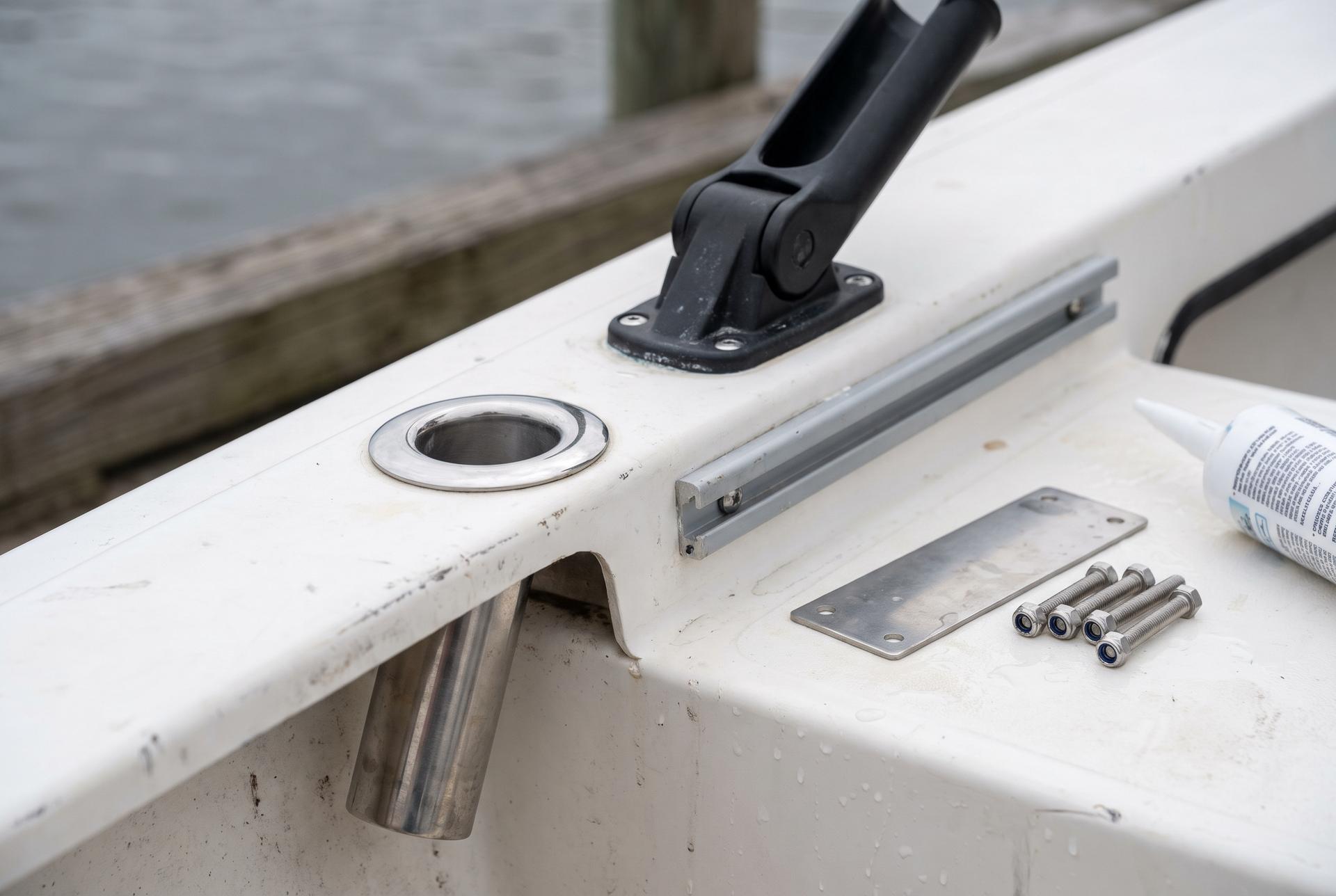
Flush mount holders drop through a hole cut in the gunwale, covering board or transom, and sit with only the rim showing. They are the strongest option because the load goes into the tube and the fibreglass around it rather than into a few surface screws, and they leave nothing to catch a net or a line. The price is commitment: you cut a hole, and the angle is fixed forever.
Surface mount and side mount holders bolt to the top or face of the gunwale with a flange. Nothing passes through except the fasteners, so they suit boats where there is no room behind the gunwale for a tube, and they suit aluminium hulls where cutting a big hole is unappealing. They sit proud of the deck, so put them where you do not walk or coil line.
Rail mount holders clamp around a round tube rail, usually on a pontoon fence, a bow rail or a T-top leg. Good ones have a pair of jaws sized for a specific rail diameter, so measure the tube before ordering. Clamp-on holders are the same idea applied to a square gunwale lip or a kayak crossbar, and they are the only mount that comes off without leaving holes.
Track mount holders slide into an extruded aluminium track screwed along a gunwale, a kayak deck or a cockpit coaming. The holder, or a base that accepts it, locks into the track and can be loosened and slid anywhere along it. Tracks are the flexible answer for a boat that fishes different ways on different days, and the same track usually carries rod holders, tackle caddies, camera arms and light mounts from the same system. Check which track profile a base is cut for, because the common profiles are not interchangeable.
Mounting angle: 0, 15 and 30 degrees explained
The degree figure on a flush mount holder is the angle between the tube and vertical, measured in the plane that tips the rod tip away from the boat. A 0 degree holder points the rod straight down into the gunwale, so the rod stands upright. A 15 degree holder leans it outboard a little. A 30 degree holder leans it well out over the water.
Vertical, or near vertical, is rod storage and bottom fishing. Rods stand clear of the cockpit, the tips are out of the way of the hardtop, and lines drop more or less straight down. Vertical holders are also what you want in a rocket launcher across the back of a leaning post, where the job is simply to carry rods while you run.
Angled holders spread lines apart. Lean two rods outboard on each side at 15 or 30 degrees and the baits track in separate lanes instead of braiding together behind the boat. The further out the rod leans, the wider the spread and the lower the rod tip sits.
There is also a twist angle on some holders, where the tube is rotated aft as well as outboard so the rod points back rather than straight out abeam. Read the product description for both numbers. On a holder with no stated angle, assume it is vertical.
One practical check before you buy: stand in the boat, hold a rod where the holder would go, and tip it to the angle you are considering. Look at where the tip lands and whether the reel handle clears the gunwale cap, the coaming bolster and the next holder along.
| Angle | Rod attitude | Typical use |
|---|---|---|
| 0 degree | Upright, tube vertical | Rod storage, rocket launchers, bottom fishing, running between spots |
| 15 degree | Leaning slightly outboard | Light trolling, drift fishing, keeping tips clear of a hardtop |
| 30 degree | Leaning well outboard | Trolling a spread, spreading lines apart, lower rod tip for working fish |
Angle is measured from vertical. Some holders add a separate aft rotation, stated by the maker as a second figure.
Materials, inserts and what protects a rod butt
Stainless steel holders are the long-term answer on a saltwater boat. Look for a polished and electropolished finish, which removes surface iron picked up during manufacture and leaves a passive layer that resists staining. Stainless still needs rinsing, and anything that sits in a wet gunwale pocket all season will show tea staining eventually if it never gets fresh water.
Nylon, glass-filled polymer and composite holders will not corrode at all, cost less and are kinder to aluminium hulls because there is no stainless-to-aluminium contact to worry about. They flex more under load, so they belong on lighter tackle and lighter boats, and ultraviolet exposure eventually chalks the surface.
Inside the tube, two details matter. A liner or insert, usually rubber or soft polymer, stops the rod butt rattling and keeps a graphite butt from grinding against metal. A butt rest or cap at the bottom of the tube takes the weight and, on better holders, includes a pin or notch that stops the rod rotating when a fish loads it up. If the holder has neither, a short length of foam pipe insulation in the bottom is a cheap fix.
Check the inside diameter against your rods. Tube holders are commonly sold by outside diameter, and a 2 inch outside diameter tube in stainless has a usable inside bore a little smaller. Heavy conventional rods with large gimbal butts need the bigger bore. A light spinning rod will rattle in it unless you add a liner.
Matching the holder to how you fish
For trolling from a powerboat, you want angled flush or rail mounts spread along the gunwale, enough of them to separate the spread, and locking of some kind so a strike does not launch the rod. Count the holders you need by the number of lines you run, then add one as a rigging station near the transom.
Offshore, the loads change everything. Big conventional outfits in a seaway put real force on the holder, so this is where flush mount stainless with a proper backing plate earns its cost. Surface mounts and clamps are not the right tool for a rod that might hook something that pulls back hard.
Kayaks and small tiller boats are where track systems make the most sense. Deck space is tiny, the right place for a rod changes depending on whether you are paddling, trolling or casting, and nothing wants a 2 inch hole cut in it. A short track either side of the seat, with bases that accept rod holders and tackle accessories, covers most of it.
Ice fishing and shore fishing use a different animal entirely: a free-standing or clamp-on holder that grips a bucket rim, a sled rail or a stake. Those are not boat hardware and do not need marine fasteners, but a rubber-lined jaw still matters for the rod finish.
If you troll under electric power, look at where the holders sit relative to the motor and the cable run before you drill. Our trolling guide covers mounting and rigging the motor itself.
Extenders, adapters and track hardware
Most rod holder frustration is solved with a piece of hardware between the holder and the boat rather than a different holder. A extender post raises a holder above the deck so the reel clears a gunwale cap or a coaming bolster. A track base or adapter lets a holder designed for one mount system sit in another. A gimbal adapter drops into an existing tube and converts it to a different fitting.
Three compatibility checks save a return. First, the post diameter: holder-and-base systems use a specific post size, and a holder from one family will not seat in another family's base even when it looks close. Second, the track profile, which varies between systems and between boat builders. Third, the bolt pattern on a surface base, because a replacement base that does not line up with the existing holes means new holes.
Track systems also carry accessories other than rods. A tackle caddy, a cup holder, a light or a camera arm on the same rail keeps everything within reach and keeps the deck clear. If you are buying track anyway, buy a longer run than you think you need, because the holes are the hard part and an extra foot of extrusion costs little.
Keep spare bases. On a boat where holders come out for trailering or for washing down, a loose base left in the track collects grit and seizes. A cap or a blank slider in the empty section stops that.
Measuring and installing: clearance, backing and drainage
Before cutting anything, measure three things. The hole diameter the holder calls for, the depth available behind the gunwale for the tube to hang into, and the swing arc the rod butt needs as you tip the rod up from the holder. The third one catches people out: a 30 degree holder near a bulkhead can leave no room to lift the rod clear.
A tube needs somewhere to drain. Flush mounts with a drain hole or a drain tube in the bottom cap should discharge somewhere sensible, not into a bilge or into a locker full of electronics. A tube with no drain will fill with rain and sit full, which is unpleasant and heavy. If the design has no drain, plan to store it with a cap.
Surface mounts and flush mount flanges need a backing plate under the laminate, a flat piece of stainless or marine ply that spreads the fastener load over a wider area. Without one, fasteners pull through a thin gunwale skin the first time a fish loads the rod. Backing plates made specifically for rod and cup holders take the guesswork out of the shape.
Bed everything in marine sealant. Holes cut through cored laminate should be sealed around the exposed core, because water that gets into end-grain core is what rots a gunwale from inside. A flexible marine sealant under the flange and on the fastener threads keeps water out and still lets you remove the holder later.
Test fit dry. Drop the holder in, put your rod in it, and sit in the fishing position before the sealant comes out. A hole in the wrong place is the one mistake that cannot be undone.
A short decision path
Start with the boat. Solid fibreglass gunwale with room underneath, and you fish the same way every trip: flush mount, and pick the angle from the table above. No room underneath, or an aluminium hull: surface mount or rail mount. Kayak, small boat, or a boat that fishes different ways: track.
Then pick the family. Long butts and heavy tackle: a tube. Short butts, baitcasters, or you want the reel accessible: a locking cradle holder.
Then check three numbers before ordering: tube outside diameter, the hole size required, and the angle. For a clamp or rail mount, measure the rail or gunwale lip. For a track mount, identify the track profile.
Last, buy the hardware in the same order. A backing plate, marine sealant and the right fasteners are not optional extras on a part that has to hold a loaded rod, and they are cheaper than repairing a gunwale.
Rod holders and mounts
Flush mount, deck mount and track mount holders currently in stock.
Mounting hardware and sealant
Backing plates and marine sealant for bedding a holder properly.
Common questions
- What angle should boat rod holders be?
- Vertical holders, listed as 0 degree, are for storage and bottom fishing. Fifteen degree holders lean the rod slightly outboard and suit light trolling and drift fishing. Thirty degree holders lean it well out and are the usual choice for spreading a trolling pattern apart. Angle is measured from vertical, and some holders add a separate aft rotation.
- Are flush mount rod holders stronger than surface mount ones?
- Generally yes. A flush mount tube passes through the gunwale, so load is carried by the tube and the surrounding laminate rather than by a handful of surface fasteners. That makes flush mounts the sensible choice for heavy tackle. Surface and rail mounts are the better answer when there is no space behind the gunwale or you do not want to cut a hole.
- How do I know if a track mount rod holder will fit my boat?
- Identify the track profile first. Track extrusions differ between systems, and a base cut for one profile will not lock into another even when the slot looks similar. If your boat came with factory track, check what the builder fitted. If you are installing new track, buy the holder and the track from the same system so the fit is known.
- Do rod holders need a backing plate?
- Any holder that takes fastener load through a gunwale skin should have one. A backing plate spreads the load over a wider area so fasteners do not pull through thin laminate when a fish loads the rod. Stainless backing plates made for rod and cup holders save you cutting one. Bed the flange and the fasteners in marine sealant as well.
- What size tube do I need for my rods?
- Match the tube bore to the largest rod butt you plan to use. Heavy conventional rods with gimbal butts need the wider bore sizes, while light spinning rods fit almost anything but will rattle unless the tube has a liner. Note that tube holders are usually listed by outside diameter, so the usable inside bore is slightly smaller.
- Will a stainless rod holder scratch my rod?
- Bare metal against a graphite butt will mark it over a season of rattling. Look for a holder with a rubber or polymer liner and a butt rest at the bottom of the tube. If the holder you have has neither, a short piece of foam pipe insulation in the base and a strip of liner inside the tube solves it for very little money.